Every in-house legal team negotiates the same clauses over and over again. With every signed deal, your team builds up valuable knowledge: what liability caps you've accepted; which indemnification language is standard for your industry; or how often mutual NDAs get pushed to one-sided. That history is a real competitive advantage, but almost none of it is accessible.
It lives in people's heads, buried in shared drives, or locked inside a CLM that nobody has time to search. So when a new agreement lands, you start from scratch. You track down whoever worked on a similar deal. You dig through old contracts. Or you make your best judgment call and move on.
That is, until today. What if you could access the full knowledge of your previously negotiated contracts with a single click?
Introducing Ivo Benchmarks
Ivo Benchmarks gives your team institutional memory, inside your review workflow, at the precise moment you need it.
When you upload a contract into Ivo, Benchmarks automatically scores each clause against your history of executed agreements. Within seconds, you can see how a provision compares to similar contracts you've negotiated before, filtered by counterparty type, industry, and governing law. Then you get a clear recommendation on whether to accept or push back.
You don’t have to hunt for answers or guess the right approach anymore. Your past becomes your strength.
How Ivo Benchmarks works
Point Ivo at your contracts, and Benchmarks begins its work.
Ivo evaluates each clause in the contracts you’re reviewing and compares them against your previously executed agreements. You can see how often your team has agreed to that exact provision before and what Ivo recommends based on that history.
When you want to understand why Ivo made its recommendations, you can see the exact language from your historical agreements. Then, you can pull relevant clauses from your contract library, compare and contrast them, and see the reasoning in seconds. The logic is always visible and traceable.
While Benchmarks works, a multi-step process is occurring to both retrieve the relevant documents your new contracts are being compared to and scored against. Here’s what’s happening under the hood:
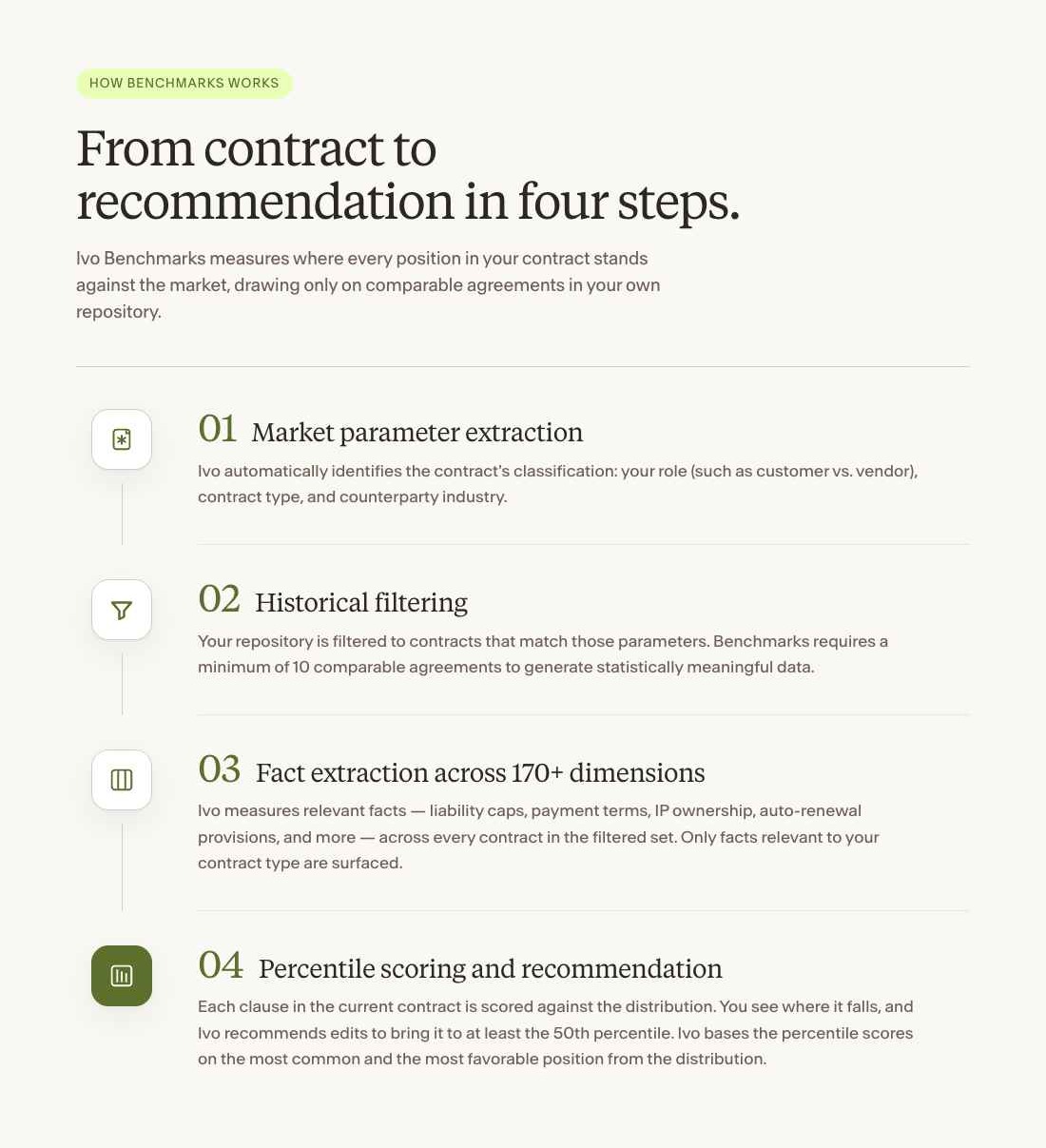
Only facts relevant to this specific contract type are surfaced. Ivo uses LLM-driven relevance filtering to skip topics that don't apply, so you're never shown a benchmark for a provision that doesn't exist in the agreement you're reviewing.
What Benchmarks looks like in practice
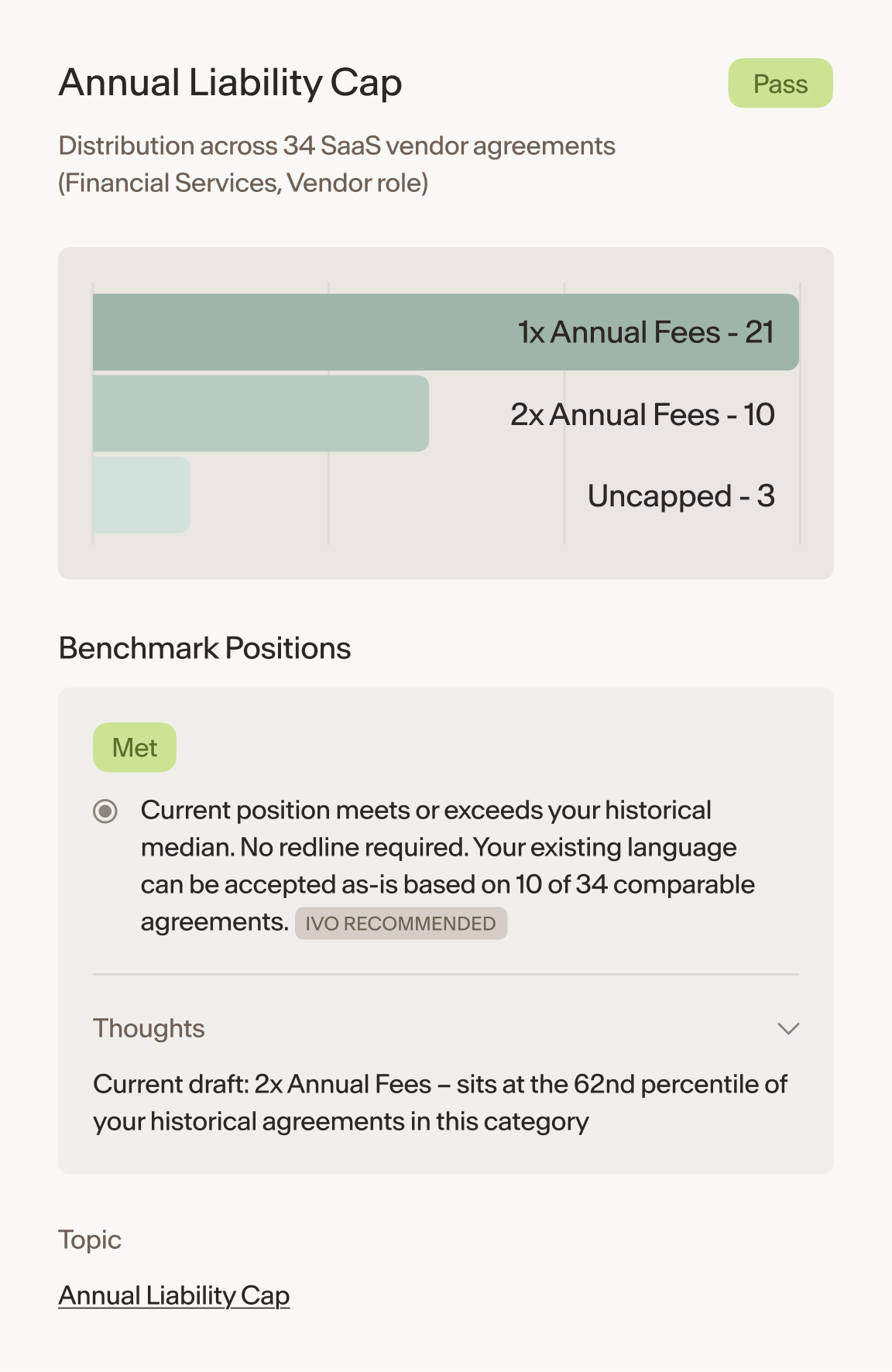
This is what Benchmarks produces when assessing annual liability caps in a SaaS agreement review.
When a provision falls below your median (for example, a counterparty is proposing uncapped liability), Benchmarks will flag it, and Ivo's review agents will draft a redline toward your 50th-percentile position, using language drawn directly from your own past agreements.
Common use cases for Benchmarks
Benchmarks is most valuable when you’re reviewing high-volume agreement types where your team has built up a considerable negotiating history. Here are the patterns we see most often:
1. Vendor and SaaS MSA review
Third-party paper · Typical library: 50–300 executed agreements
Benchmarks can measure liability caps, IP ownership, data processing terms, SLA minimums, and auto-renewal windows against your history with your vendors. When a vendor proposes a mutual indemnification clause you've never accepted, Ivo will flag it with a finding like “accepted 0 of 67 times.” It will then suggest language from the agreements where you held the line.
2. Customer contract negotiation
Own paper · Typical library: 100–500 executed agreements
Benchmarks tells you how many concessions you’ve made in the past on your own paper. If a customer is pushing for a shorter term than you typically accept—say, 12 months vs your standard 24—the feature will surface a pattern like 82% of comparable deals closed at 24+ months, giving your team a data-backed position to help you respond.
3. NDA and confidentiality review
Both paper types · High volume, lower stakes per agreement
For high-volume, lower-stakes agreements like NDAs, Benchmarks is useful. Your team has signed hundreds of these; Ivo can tell you whether a one-way NDA (instead of mutual) is something you've consistently pushed back on (accepted mutual structure 91% of the time), or whether it's worth the round trip.
Benchmarks and your playbook, working together
Benchmarks adds to your existing playbook positions; it doesn’t replace them. When a benchmark overlaps with a playbook item, the playbook position always takes precedence. Where you have playbook coverage, benchmarks add historical context, and where you don't have playbook coverage, benchmarks can fill the gap automatically, surfacing facts your team has taken positions on through hundreds of past deals.
Every benchmark recommendation shows its sources, which are the verbatim clauses from your historical agreements that define the distribution of the legal positions.
Getting started
Benchmarks activates when you connect a repository of your executed agreements to Ivo. The minimum threshold is 10 comparable contracts in a given category, although most teams find meaningful benchmarks emerging around 25–50 agreements and richer distributions forming at 100+.
Once your repository is indexed, Benchmarks runs automatically on every new review. There's nothing to configure: Ivo extracts the market parameters from any agreement you review and pulls the right historical comparisons.
Benchmarks is now generally available (GA). See it in action.