
Ivo is excited to announce that we have achieved ISO/IEC 42001:2023 certification, the international standard for artificial intelligence management systems. Issued by Johanson Group on September 18, 2026, the certification recognizes Ivo’s AI management practices against an evaluation framework designed to help organizations govern AI responsibly and manage AI-related risks.
As legal teams bring AI into contract review and other consequential workflows, knowing how the company behind it manages the risks associated with its use is crucial information. ISO 42001 provides an internationally recognized framework for establishing, implementing, maintaining, and continually improving AI management systems, one that Ivo has been and will remain committed to upholding.
ISO 42001 focuses specifically on AI management. The certification addresses how organizations establish policies, assess risks and impacts, define responsibilities, and maintain processes for the responsible use of AI. Unlike information security standards that focus primarily on protecting information and systems, ISO 42001 provides a framework for governing AI systems and their associated risks.
This is an important distinction for organizations evaluating AI for legal work. Contracting work involves more than generating simple text. Just as a human attorney’s output must adhere to professional standards set by the legal field, legal AI systems should operate within defined expectations for quality, oversight, and responsible use. A formal AI management system helps establish the organizational processes for instituting responsible use going forward.
Ivo’s certification followed a two-stage audit process designed to evaluate both 1) the structure of its AI management system and 2) how it operates in practice. The first stage reviewed the policies, documentation, and governance processes underpinning Ivo’s approach to AI, including the roles and responsibilities established to oversee it. The second stage examined how those processes are implemented; in other words, verifying that the documented policies translate into operational practice. Ivo completed both stages with zero non-conformities, meaning the audit identified no instances of non-fulfillment of the standard’s requirements.
The certification reflects Ivo’s conscientious commitment to responsible AI governance, and complements the other independent assessments and certifications passed by Ivo, including ISO 27001, SOC 2 Type II, and Cyber Essentials. Together, these credentials give customers greater visibility into the standards and controls that form the foundation of Ivo’s approach to security and AI accountability.
Ivo helps legal teams apply AI across the contract lifecycle, from reviewing and redlining agreements to extracting intelligence from contract portfolios and managing the contracting process. As organizations expand their use of these tools, governance needs to keep pace with adoption.
ISO 42001 certification is one part of that work. It establishes a structured framework for managing AI-related risks and responsibilities, while reinforcing the importance of ongoing oversight as technology and customer needs evolve.
Certification is not the end of the work. Responsible AI requires continued attention to how systems are governed, evaluated, and used. Ivo will continue investing in the practices that support customers as they bring AI into their legal workflows.
Ivo’s ISO 42001 certificate is available alongside its other security and compliance information at the Ivo Trust Center.
Behind every clean redline lies dozens of nuanced judgment calls. Before a single word of a contract is actually edited, the attorney must make decisions like what the change should be, how to escalate it, and whether a change is necessary at all. Historically, there have been no benchmarks to measure just how well a contracts AI tool can perform this layered and sophisticated work.
That’s why we’ve created ContractBench, a benchmark built in partnership with micro1 to make these processes visible and measurable. We’re publishing ContractBench along with our methodology, the public dataset, and the results of running it against seven frontier models.
Other legal benchmarks simply grade the edits a model makes. While this metric is technically reasonable, it doesn’t fully measure the effectiveness of a model. For example, an attorney who identifies every limitation of liability clause in an agreement and redlines them all has produced a technically thorough review—just at the cost of true efficacy and efficiency.
What makes a review truly effective comes down to the decisions made before the physical edits. These involve determinations like which issues are worth the negotiating capital, when acceptable language should be left alone, when a standard position should be adjusted based on the specifics of this deal, and when a call should be escalated to someone more senior.
Models are increasingly able to handle more of the end-to-end review process, including these context-dense judgment calls. As models evolve from suggesting changes to executing them, legal teams need to know which decisions a model can handle reliably and which need a human lawyer’s judgment. A single accuracy metric cannot determine that capability, and neither can a benchmark that only looks at edits.
ContractBench contains 350 contract-review tasks across 35 scenarios and five agreement types: MSAs, IP licensing agreements, research partnerships, commercial leases, and marketing agreements. Half the tasks are opening redlines on a clean agreement, and the other half are responses to a counterparty’s markup.
Everything used in building ContractBench was written by contract attorney experts: the contracts, the playbooks, the commercial context for each deal, and the judgment criteria. The generated scenarios vary with regards to whether a playbook exists and how detailed it is, which allowed us to measure how much explicit company rules affect a model’s performance.
Each model receives the Word document, the representing party’s playbook, the commercial context, and a brief explaining which party the model represents and what decisions will require approval. Every judgment call made then falls into one of four action categories:
When responding to a counterparty redline, the Edit action further branches into a choice of either rejecting a change, countering it, or introducing a new point, while the Preserve action provides a choice of either accepting a proposed change or leaving the language untouched.
The machinations of the Escalation action required a different process, given that whether an escalation is not represented in the final, physical document. The benchmark criteria thus evaluate the efficacy of an escalation by looking at whether a) an escalation was required and b) who should receive it. A model thus earns full credit on this metric by identifying both in a comment, and how the issue is ultimately resolved is not scored.
Combining each rubric item’s action, priority, and grounding produces five dimensions of contract-review judgment upon which the models are scored:
Separating these metrics into discrete fields is crucial for the integrity of the evaluation. A model can be, for example, strong at restraint and weak at prioritization, and neither can be improved unless they are evaluated separately.
Lastly, five attorneys reviewed each scenario independently, so every model is graded against five expert views rather than one. We determined this to be a necessary safeguard in a field where experienced practitioners can reasonably disagree.
Models are capable reviewers. On the opening redline, they catch the issues an experienced attorney would, and apply playbook positions correctly when such positions are provided.
However, distinct gaps still exist. In situations where there was a playbook rule given, the model often failed to recognize when a particular deal called for a deviation from that position.
Other notable results are the following:
Restraint is the strongest skill. Leaving acceptable language alone is the highest-scoring action for every model we tested. The other actions leave considerable room to improve.
Reconciling a playbook with the facts of a deal is the most interesting open question. Models apply an unconditional playbook rule well, but score consistently lower when the right position depends on the particulars of the transaction. Every model failed at this to some degree. The commercial context was available to the models the whole time, so the research question now is how that information gets connected to the relevant decision.
Escalation is the largest untapped skill. Models had approval boundaries, written instructions on when to escalate, and a dedicated tool for doing it. However, they largely did not do so. Knowing a rule exists and recognizing the moment you have reached its edge are different skills, and this result tells us that more training is needed in this area.
Edits land in broad strokes. Attorneys make 64% of their changes inline, averaging 93 characters. Models tend to rewrite whole blocks. This is less a question of quality of judgment and more one of how that judgment is applied differently between human and AI reviewers. Human editors tend to send the majority of the language back to the counterparty as written, while models will rewrite large swathes even when only a small, surgical edit was technically necessary.
We designed ContractBench to outlast the models it ranks today. ContractBench measures specific judgment calls rather than performance against a fixed level of difficulty, so it will stay meaningful as capabilities improve. Ivo will continue to use it in our own model development, and we invite others to do the same.
Keeping substantive judgment as the leaderboard signal keeps the benchmark a clean target for post-training, which we believe should remain the priority. Attorneys should likewise remain in the loop, as practitioners need to know in what respects a model’s output is ready to send and where the output requires a second look.
We purposefully designed ContractBench to report substance and style of redlines separately. “Substance” here refers to whether a model’s edits identify the right issues and reach the right legal positions; “style” measures whether it expresses those positions in a redline an attorney would actually send, given the business context. This is important because metric that ranks on substance alone can potentially reward a model that reaches the right positions, but through, for example, extensive rewrites that no attorney would actually send.
As models handle more of a redline end to end, the benchmark should reward a redline that is right on both substance and style, and is ready to send as written. This is what Ivo is working towards with ContractBench.
Models will undoubtedly keep getting better at standard positions. The next gains will come from the application of nuanced judgment: reading a deal’s context, knowing when to hold back, and knowing what to ask and when. These calls depend on layers of complex context that no single document holds, such as the history with this counterparty, the business reason behind a deadline, and the person who needs to sign off.
A benchmark that measures those skills gives the field something to build against, and we intend to help lead that work. Better models made everything Ivo does today possible, so every advance in judgment strengthens what we offer our customers. By publishing ContractBench openly, we accelerate progress that shows up directly in their redlines.
For legal teams, that progress means a model that can handle the brunt of the work accurately, but also accurately knows when to call upon an attorney’s judgment. ContractBench gives the field a precise way to measure how close we are to that goal, and provides a blueprint for how to improve models for contract work.
With Ivo Assistant, you can create a repeatable Skill that turns any repeat task into something you can run with a click, or schedule to run all on its own.
Every legal team has certain tasks it needs to run exactly the same way, time after time, week after week: vendor review against the playbook, the renewal report for the business, a scan for new privacy rules. Ivo Assistant Skills is a function that can take the manual repetition out of these tasks and run them repeatably, automatically, and consistently.
While a saved prompt is just text, a Skill contains much more. Skills bundle the instructions for a specific task along with everything else it needs to complete it, such as playbooks, Repository rooms, reference documents, and any necessary capabilities like web search and deep research. Skills only need to be set up once; after that, the entire workflow contained in the skill can be run immediately just by typing “/” and the name of the skill into Assistant.
A Skill is made of a few components. Only the first three are required, and the rest are addable as necessary to further hone it and add additional context.
The easiest way to create a Skill is to ask Assistant to do it for you. Say what you need in plain language, and Assistant will draft the instructions.
For example, you can tell Assistant something like, “Create a Skill that reviews the agreement against my vendor agreement playbook, checks any hyperlinked terms, flags incorrect clause references or defined terms, and gives me a consolidated list of redline recommendations.” Assistant will draft the instructions for that skill for your review, and you can then attach your playbooks and reference documents.
If you already have a prompt you like, you can go to that and click “Convert to Skill” and Assistant will then walk you through the conversion.You can save a Skill just for yourself, or publish it to a team or the whole workspace.
Set a personal Skill to run daily, weekly, or monthly, at any time you choose. For example, you can make a Skill that reviews every legislative and regulatory update relevant to your business from the past week, then delivers an actionable report at 9 a.m. each Tuesday. You can go a step further and have the same Skill that then compares each change against your DPA playbook, then recommends the playbook edits needed to stay compliant.
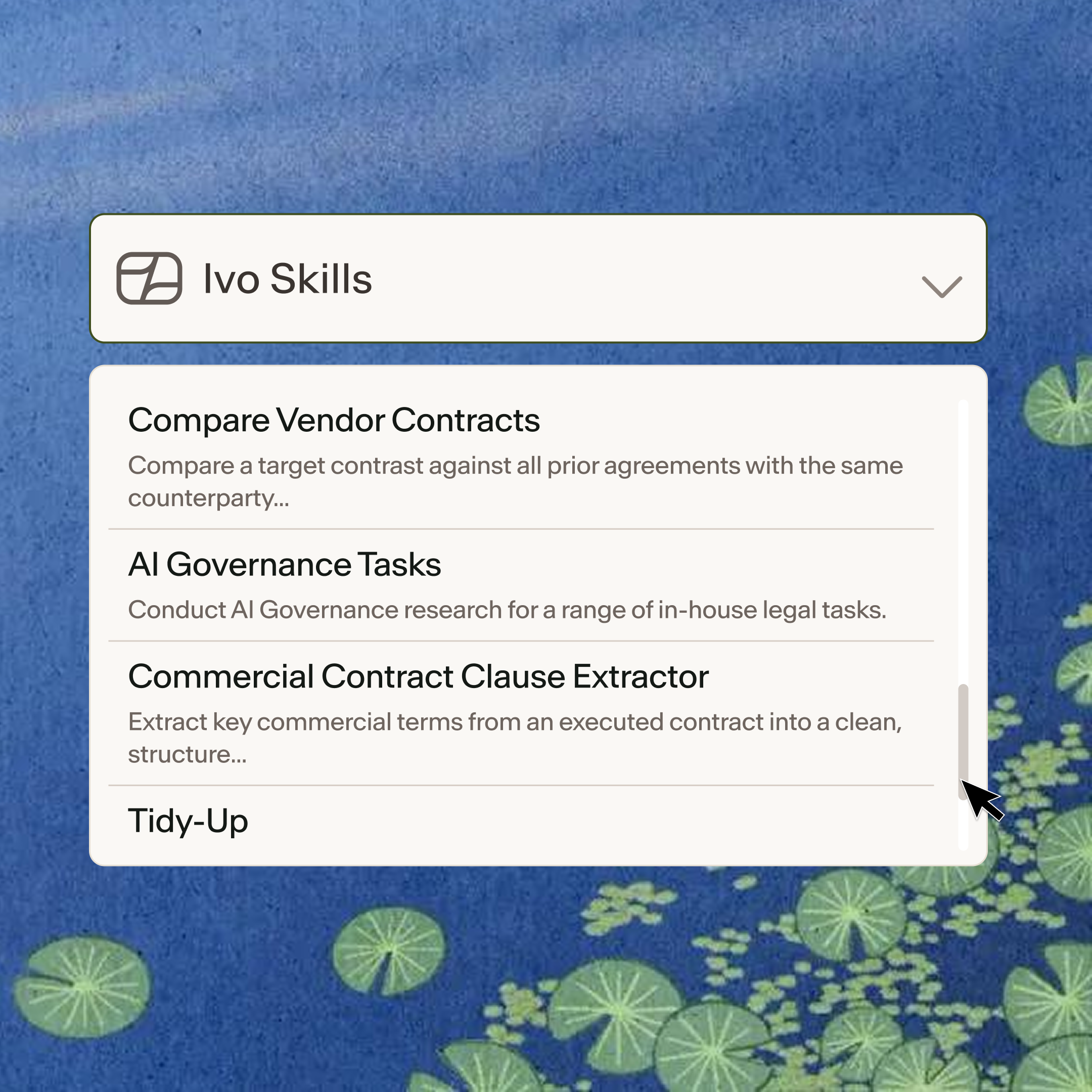
The Skills Library automatically comes with 10 sample Skills, each built for a specific kind of legal work. Some example Skills are:
You can try these skills as written, or clone them and adjust it to the instructions to match how your team works.
Skills have been available since July of 2026, and customers have already put them to work. Within days of launch, they had created hundreds of Skills across workspaces, with half of them focused on contract review or redlining.
To build your first skill, you simply need to pick the task your team repeats most often, open Ivo Assistant, and describe it. Assistant will draft the Skill, and you attach the playbook or room it needs. Now, the next time that task comes up, you simply type “/” and the Skill name, and you’re good to go.
Learn more about Skills in our help article or watch this video.
Contract work is a difficult task for most LLMs. General purpose AI models excel at short, one-off tasks, particularly those that require broad knowledge and quantitative, non-context-dependent analysis. Contract work is the opposite of this. Contracts are long and complex, requiring nuanced judgment, layering of tasks, and heavy dependence on context. Often there is no clean, single “right answer” to a contract question, only a better judgment call requiring nuanced analysis. General purpose models have improved enormously, but none of them can yet perform this kind of work the same way an experienced human attorney could.
We believe that we will see significant gains in AI performance from specialized research efforts to teach models the specific work of contracting. Ivo has started doing this research, and today we're sharing the first major result.
Sage is our free, open-source model, post-trained for long-horizon contract work. It's available to download today, along with the method we used to build it and the full dataset we used to train it. Read on for details on why we built it, what we found, and why we chose to release it openly.
Post-training is how a model learns a specific job. One way to frame it is that a general-purpose model is like a recent law school graduate: trained in many different areas of law, but not yet an expert in any. A post-trained model is like an attorney who has practiced for some time and specializes in their practice area. While they may be equally intelligent and capable, the second knows how this specific work is done, and can do it faster and more effectively.
When applied to contract work, post-training a model changes how it behaves across a whole assignment. A post-trained model can learn to use its tools more efficiently, pull in the right context at the right moment, reach conclusions in fewer steps, and produce a finished deliverable that is much closer to the desired result than what a non-post-trained model would produce. It also makes performance measurable against the metrics that matter; in this case, whether the work product meets the standard a legal team would expect.
We think this is one of the most important and least understood levers in legal AI. General purpose models are a strong starting point, but the biggest gains come when we teach them the specialized work of contracts, to the standard a legal team expects.
Sage is built on DeepSeek V4 Flash, a publicly available open model. We post-trained it using reinforcement learning, a method that improves a model by rewarding outputs that score well against defined criteria.
Our training ground was the Legal Agent Benchmark (LAB), a public set of long, multi-step legal assignments covering general legal practice and contract work. We trained Sage on 1,040 LAB tasks. For each one, the model worked through the assignment in the benchmark's own environment, using a small set of tools to read, write, edit, and search files. Its output was then graded against expert-developed criteria, and those scores guided the model toward better work over repeated rounds of testing.
To make sure Sage learned the work rather than memorizing answers, we set aside 180 tasks from the 1,040 and kept them out of training entirely. Only after training did we use them to test the model (picture giving a student an exam made of problems they've never practiced). We also kept tasks built on the same agreement together—either all in training or all in the test—so Sage was never tested on a document it had already seen.
No customer data was used at any point, and Sage was trained only on public tasks. We built Sage in partnership with River AI, who provided valuable training infrastructure support. Training a model of this size takes serious computing capability, and River's support helped make this work possible.
Contract work happens at volume, across thousands of agreements, so what a model costs per task matters as much as how well it performs. A model that does excellent work at an unsustainable price may be an interesting research result, but it’s not something a real legal team can practically build on.
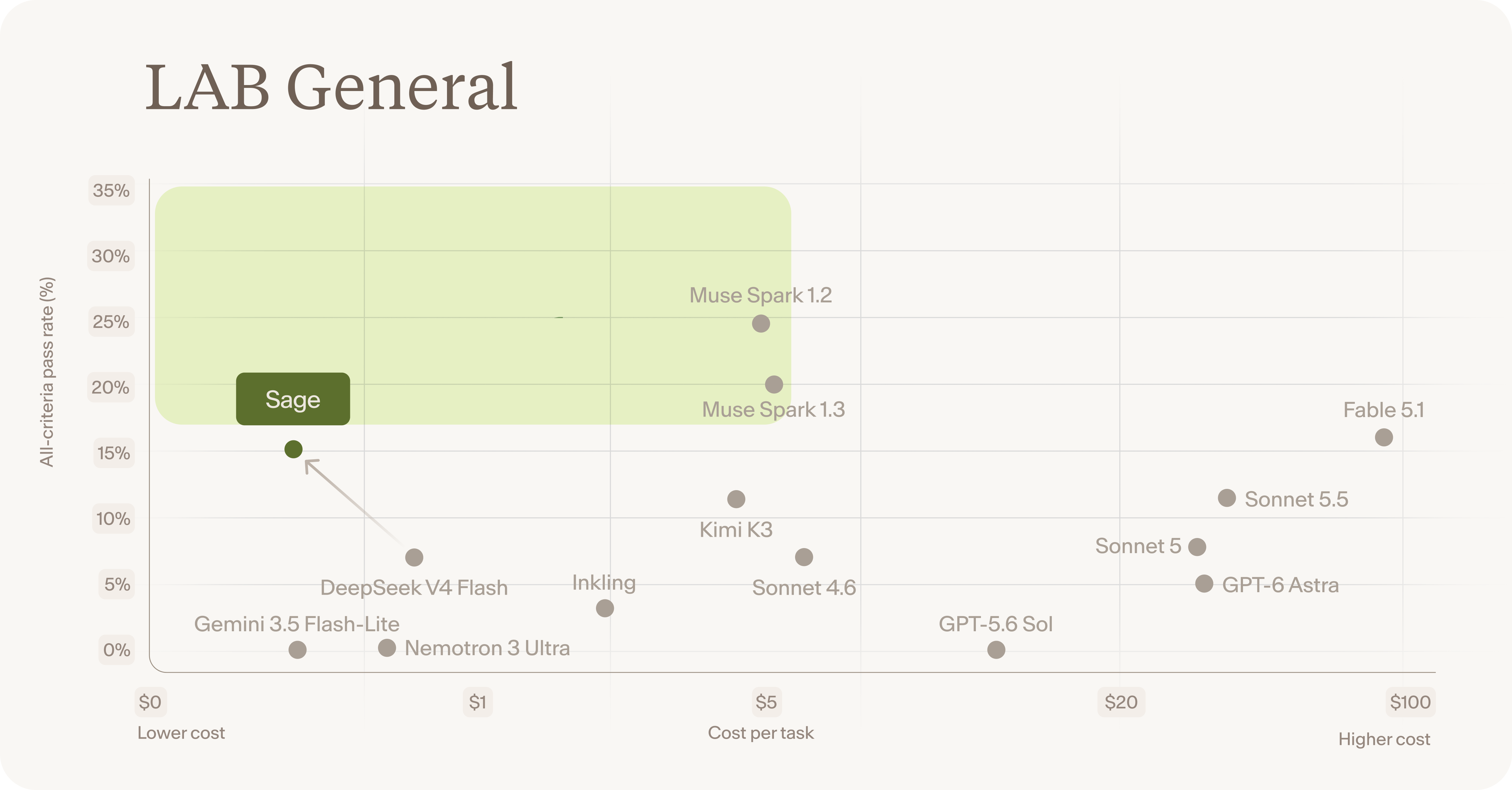
Thus, in making Sage, we made cost a central metric. We ran Sage alongside 13 other models, including the leading frontier models, on the same 180 held-out tasks. We then tracked cost per task, a measurement that reflects each model's own token usage at its provider's list price.
We scored each model two ways. The first is the criterion pass rate, or the number of individual requirements a model satisfies across assignments. The second is the all-criteria pass rate, a much stricter measure that tracks the percentage of tasks that the model completed while satisfying every requirement.
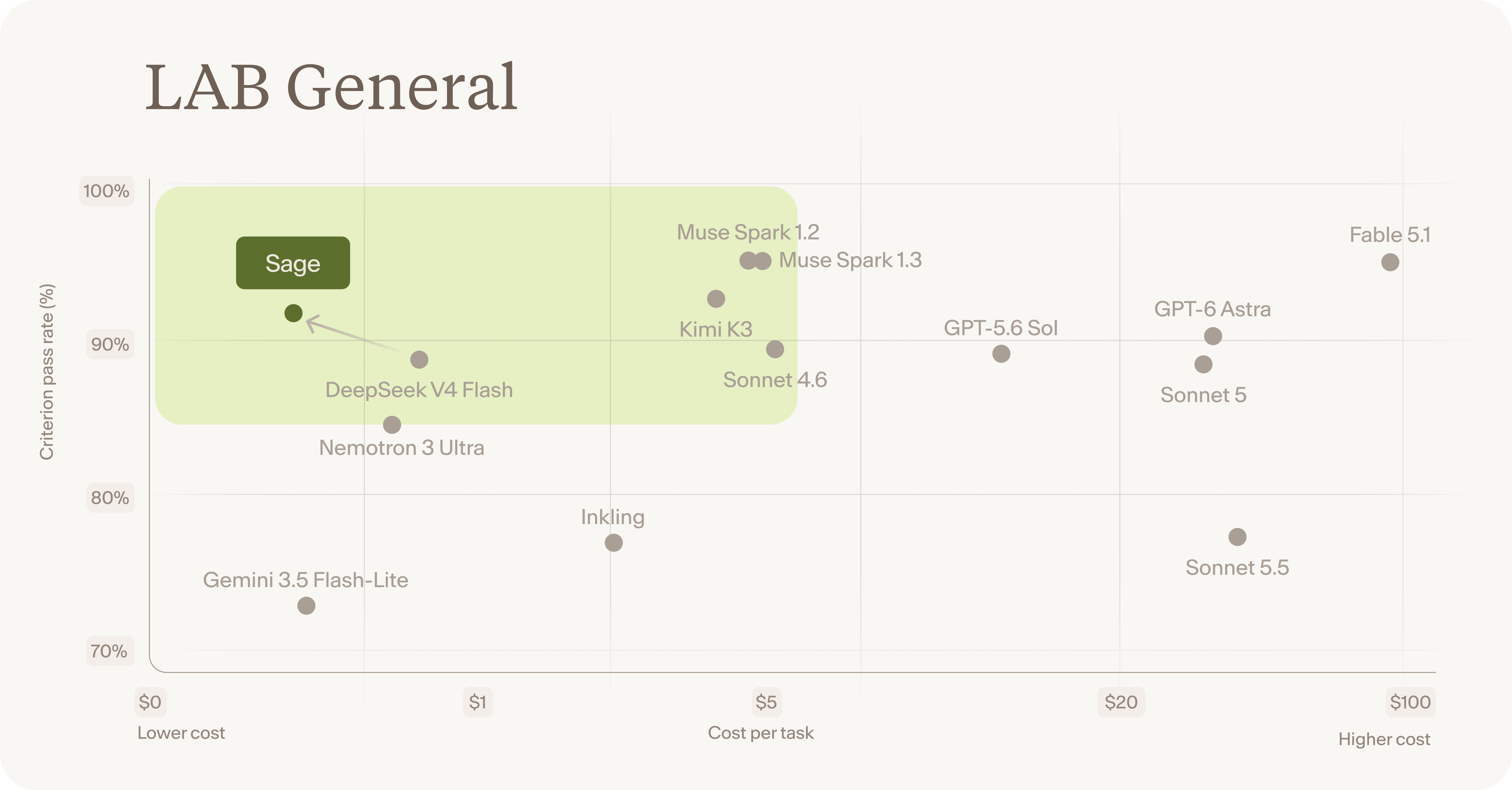
On general tasks, Sage's all-criteria pass rate of 15.2% is comparable to Fable 5.1's at 15.7%. However, a remarkable difference is seen when we compare the price. Sage costs $0.40 per task, while Fable 5.1 costs $92.46. This puts Sage at an almost identical effectiveness, just at about 0.4% of the cost.
Sage also exceeded Kimi K3, GPT-6 Astra, and GPT-5.6 Sol on the same measure. Among the models that reached a criterion pass rate above 90%, Sage was the least expensive by roughly a factor of nine.
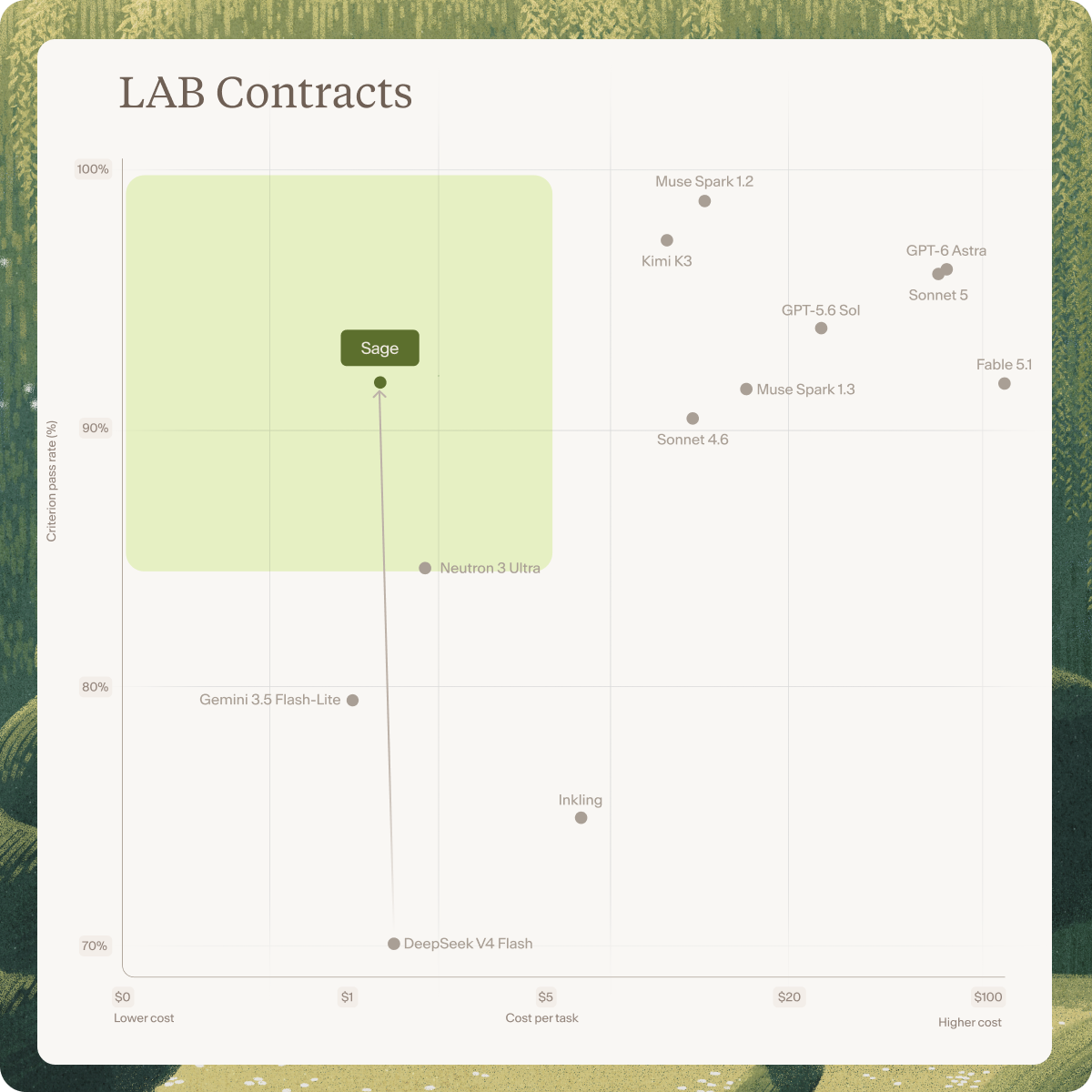
Contract work is where post-training made the biggest difference. Sage met 91% of grading criteria, compared to 70% for the DeepSeek V4 Flash base model, representing a gain of more than 20 points from training on contract work alone. It did this at a cost of $1.24 per task, while Fable 5.1 cost $142.39 on the same suite of tasks. Among models above the 90% mark, the next least expensive costs roughly eight times as much.
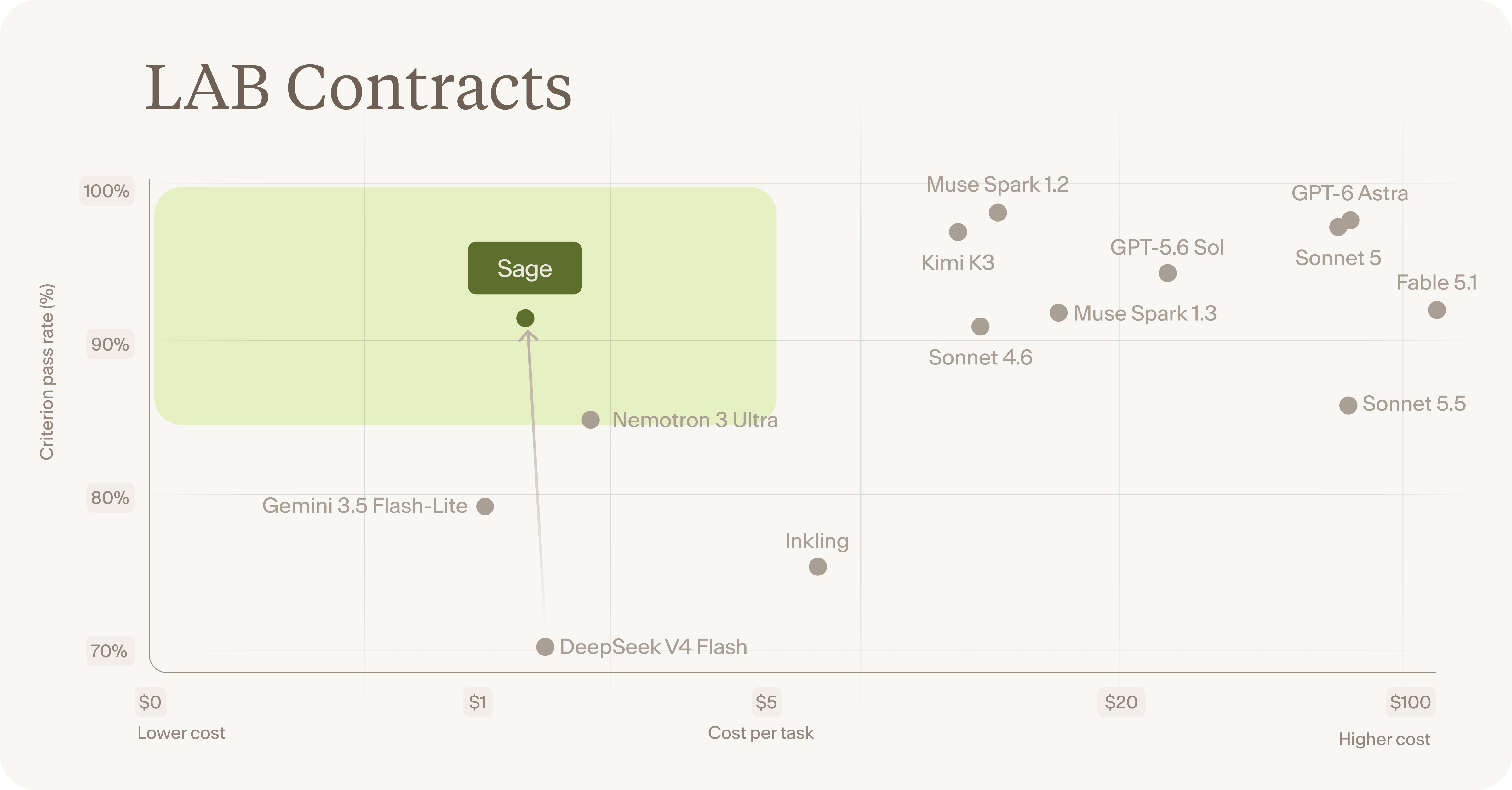
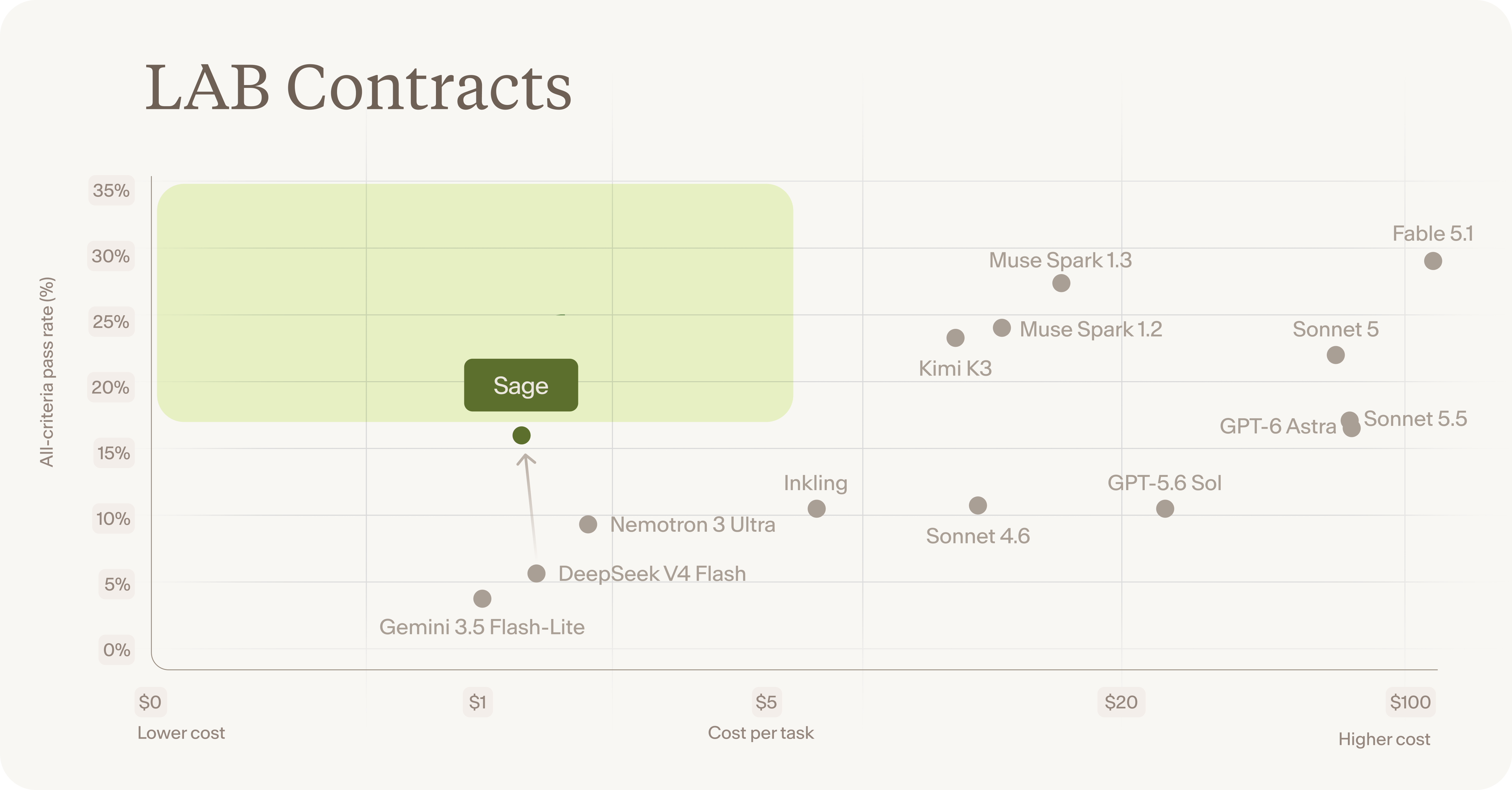
Overall, Sage offers the best balance of accuracy and cost of any model we tested. On both LAB General and LAB Contracts tasks, and on both ways we score the work, Sage sits on the frontier of performance against cost (as represented by the light green box in the graphs above).
Post-training changed how Sage works, not just how well it scores. Across all 180 held-out tasks, the average assignment took 25 turns, down from 31 for the base model, and Sage used 21% fewer tokens. In practice, Sage learned to reach conclusions in fewer steps and to use its tools more effectively. That efficiency is also why it costs less per task than the model it was built on.
We also tested Sage on benchmarks outside its training. On RedlineBench, an independent benchmark for contract redlining, its score rose from 30.8 to 45.7. And on LegalBench, a broad test of short-form legal reasoning, it scored 83.0 against the base model's 83.1. Specializing in contract work didn't come at the expense of general legal reasoning.
Most AI used for legal work is closed. Some legal AI companies have announced post-trained models, but few have made theirs open-sourced. Ivo is the first to release an open-source model post-trained for long-horizon contract work.
We chose to make Sage open-source for three reasons.
Progress in a field like this depends on shared work. There's remarkably little open research on AI for contracts. We'd rather contribute to a foundation for this work than to guard one, because the whole field—and the field of law at large—improves faster when people can build on each other's results.
Transparency lets people check our work. Alongside the model, we're publishing our training method and evaluation record: task lists, evaluation transcripts, deliverables, and the judge's decisions. Anyone can inspect what the model did and how it was graded, rather than just taking our word for it.
Every legal team's work is different. Contract complexity varies enormously, from a Fortune 500 legal department to small businesses to agreements between individuals. An open model can be fine-tuned on a team's own data, adjusted with its own rules and safeguards, and adapted to its own use cases.
Sage is released on Hugging Face under an MIT license, which generally permits commercial use, modification, and redistribution. It remains subject to the terms of its underlying base model. To our knowledge, Sage is the first open model from a legal AI company post-trained for contract work. Open legal models have existed before, and we're building on that foundation.
Advancing contract AI takes building the technology, measuring it honestly, and pushing the entire industry forward. We see Sage as an early step in this important work, and we're excited about where it leads.
In the meantime, we’ll keep researching, keep sharing, and keep being your trusted source for contract AI.
Download Sage on Hugging Face here.
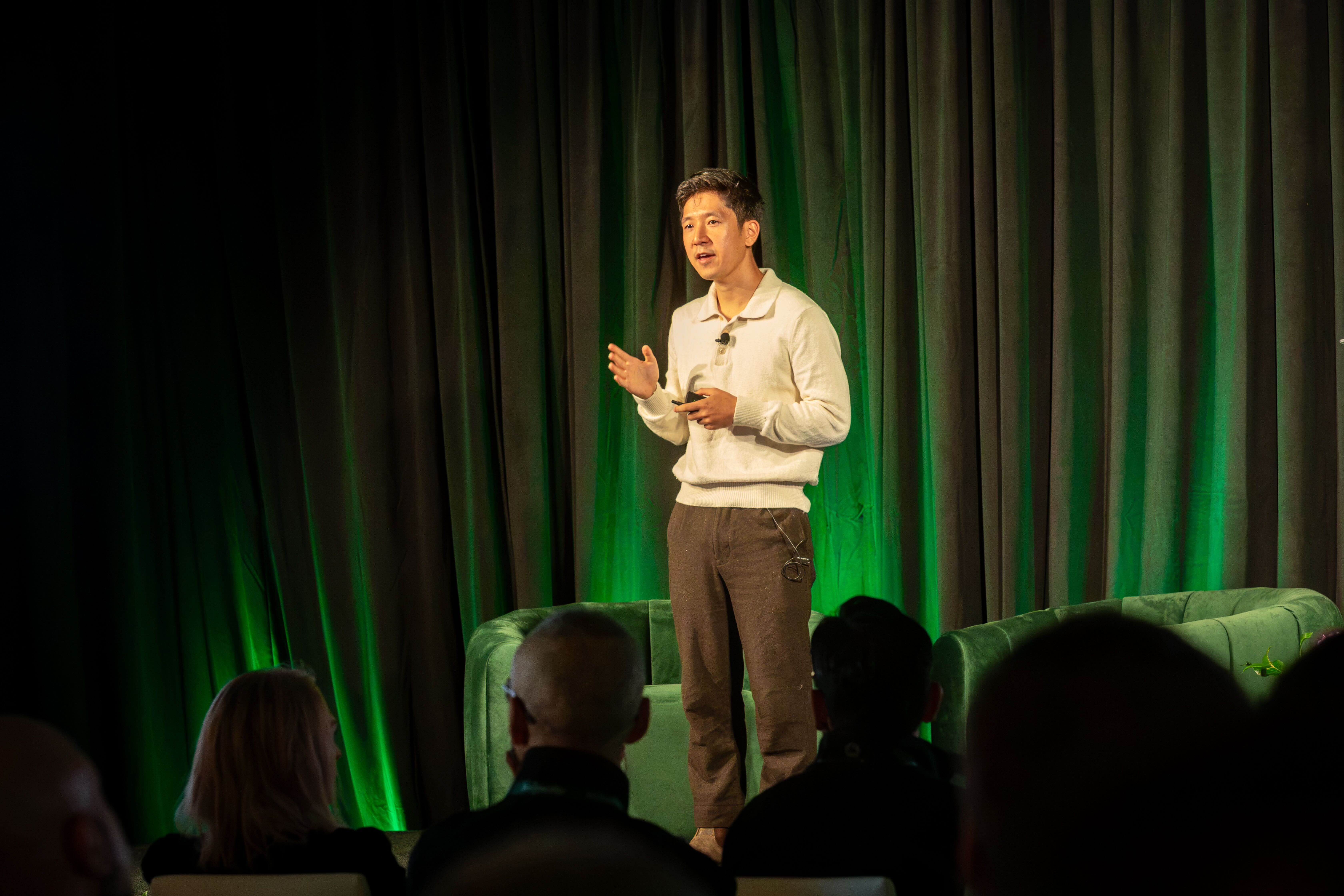
At Inscribe, Ivo’s first user conference, we announced three developments in our mission to push contract intelligence forward: Ivo Collaborate, a new way to leverage and apply contract intelligence across intake, negotiation, and approval; the Ivo–Micro1 Contract Bench, a benchmark for measuring AI’s actual judgment and effectiveness in contract review; and Ivo Sage, an open-source AI model post-trained for long-horizon contract work.
Together, these announcements reflect a broader shift away from software that simply organizes contracts workflows towards technology that reflects the way lawyers actually work while enabling them to uplevel their value to the business. With these releases, Ivo aims to not only reveal the business intelligence hidden within contracts, but to provide the frameworks and technology that will advance it even further.
Ivo Collaborate brings the entire contracting process into one place, from intake through negotiation, approval, and signature. Collaborate gives the negotiation process itself a system to live in: it allows the decisions, positions, and concessions that shape each deal to be managed in context and in one location, all while retaining the data from that process as intelligence that your team can utilize going forward.
Unlike how a CLM simply routes documents based on a predefined field, Collaborate actually reads each contract as it arrives, then assesses the agreement against the playbooks and rules set by the legal team before routing it accordingly. Low-risk agreements can move directly to signature, while those with risks that require further judgment are escalated to the right reviewer, with all the relevant context already identified.
With Collaborate, anyone in the organization can start a deal request directly, removing the traditional legal bottleneck at intake while making sure that legal’s judgment is consistently and effectively applied across all the organization’s agreements. The result is a system where legal can define how the business contracts across every deal without the need for laborious manual review, and all while capturing what the organization learns along the way—turning every negotiation into an opportunity to make the next deal smarter.
Read more about Collaborate on our blog here.
Ivo has released a new contract review benchmark, developed in collaboration with data lab and research partner Micro1. The Ivo–Micro1 Contract Bench was developed to evaluate aspects of contract review that conventional AI benchmarks can miss. Many existing approaches to evaluating AI models for contract work focus on whether the model can simply identify issues and make edits. However, real contract review requires knowing things like what not to change, how to adapt a position to the deal’s circumstances, how to execute established positions in context, and how to effectively recognize when an issue should be escalated to a human. Most models aren’t judged on these kinds of nuances, like the precision, efficiency, and effectiveness of edits.
The Ivo–Micro1 Contract Bench evaluates contract review effectiveness based on the decisions and judgement calls that real attorneys make. Our contract bench evaluates models across five dimensions: issue prioritization, negotiation restraint, situational judgment, escalation judgment, and standard-position execution. Ivo–Micro1 Contract Bench thus uses contract-review tasks, detailed playbooks, deal context, and counterparty redlines in its review, with the criteria used to evaluate model decisions established by real attorneys.
Early findings show that, against these benchmarks, leading models concede easily and push back poorly: when the right response is to counter or reject a provision, they get it right only 46% of the time. When the right response is to escalate an issue to management, the leading models meet only 23% of the escalation criteria. These results highlight a real discrepancy between existing review standards and criteria that would lead to meaningful and effective review.
A public set of these benchmark results, along with the dataset used for the benchmark criteria, will be available in the coming weeks.
Ivo research efforts have also produced Ivo Sage, an open-source model that is the first to be post-trained for long-horizon contract work. General-purpose frontier models are built to handle a wide range of tasks; however, contracting requires a much more specialized set of skills. Contracts are long and complicated documents, necessitating multi-step legal reasoning and deep context to adequately review. Post-training gives an AI model the opportunity to learn these patterns and tasks more effectively and surgically, rather than approaching every contract as a general-purpose problem.
The Ivo Sage model was built in partnership with River AI by post-training DeepSeek V4 Flash specifically for complex contract work. This was done using both public and synthetic data generated by real attorneys, with River providing valuable technical and training infrastructure support. After reinforcement learning, the model went from scoring 70% of the pass criteria of the Legal Agent Benchmark (LAB) Contracts to 91%. Overall, Ivo Sage reached comparable quality of much larger frontier models, with higher token efficiency at a fraction of the cost.
Unlike other legal AI companies, Ivo is releasing the Ivo Sage mode as an open-source model. Ivo Sage is being released along with its research and evaluation record so that researchers, developers, and legal tech builders can download it, study how it performs, and build on it. Our goal is to make progress in legal AI more transparent and collaborative. By sharing our model and the work behind it, Ivo is hoping to give others a foundation they can test and improve as contract-specific AI continues to develop.
Ivo Sage is available to download on Hugging Face here.
Ivo is committed to making everything surrounding contracts better, smarter, and more intelligent. That means building technology that can meet the complexity of legal work, creating new ways to improve what AI can do, and making the underlying research accessible enough to move the whole field forward.
Our work is still evolving, but the direction is clear: a future where contracts are not just documents to manage, but intelligence that moves the business.

Ten sessions, two tracks, one day. Here's how to decide where to be.
Inscribe starts at 9:30 with HubSpot's chief legal officer and Ivo CEO Min-Kyu Jung discussing how AI will transform the future of legal and contracting. The day closes at 4:15 with another fireside chat with Ivo VP of Partnerships Kristin Hagan and Acrew Capital's Aliisa Rosenthal, who joined OpenAI as its first commercial hire and spent three years watching a thousand enterprises attempt the same change most companies are attempting now.
The Strategic Track tackles the big-picture issues facing legal teams today: how to roll out new systems of working, how to position legal as a partner in the business, and how to parlay legal knowledge into nontraditional roles as the field evolves.
The Practitioner Track is about how the work actually gets done: practical tips on building systems, crafting playbooks, and solving the specific contracting problems your team experiences every day.
Every time slot has a session from one of each running concurrently, so feel free to go between the two tracks and build your perfect agenda out of the sessions that speak to you.
10:30 a.m. - Driving Adoption Across a Team. Join this session to hear real solutions to the problems millions of teams are living in 2026: the AI pilot went well, a few people became power users, and then nothing moved for months. Contract ops leaders from IBM and Intel will speak on how to find the internal champions, set expectations that survive the novelty wearing off, and bring skeptics along without slowing down the people already moving.
11:25 a.m. - Building Playbooks Your Team Will Actually Follow. This session is the logical follow-up to Driving Adoption Across a Team. Adoption often fails when standards aren’t consistently upheld, and an effective playbook is key to a successful rollout. This session discusses how to craft playbooks that hold up under deal pressure, stay current as the business shifts, and are applied the same way across reviewers.
2:40 p.m. - Legal Ops as a Strategic Function. This session features legal ops leaders from DoorDash, Figma, and LegalOps.com discussing what they’re automating and how the role is changing. They’ll discuss the variety of functions owned by legal ops teams and how each panelist has formed their own approach.
That leaves 1:45 open. Take Under the Hood if you're still evaluating tooling.
10:30 a.m. - From Back Office to Business Partner. Hear from senior counsel from Pinterest, Atlassian, and Vercel, who have all moved legal teams from decision reviewers to business strategists. You'll hear how legal knowledge holds business insights, how these panelists earned earlier involvement in decisionmaking, and what changed once they became partners with the rest of the business.
11:25 a.m. - Contract Intelligence as a Source of Business Insight. This session is all about the argument for legal becoming the function that holds answers for the rest of the org. A contract portfolio is the full record of every promise made and every dollar owed, and is a major asset in the business that almost nobody leverages. This session will discuss the insight held in contracts and how to hand off that information to procurement, finance, and sales ops.
2:40 p.m. - Legal Ops as a Strategic Function pairs well with both to round out the day.
1:45 p.m. - Under the Hood. Our Head of Engineering will talk about the legal AI problems users never see: scaling to millions of contracts, keeping everything secure and fast, and turning a prototype into infrastructure a global legal team can rely on. He’ll cover the constraints that shaped Ivo and the bets that paid off. If you're in a buying process, this is the closest thing on the agenda to technical due diligence.
2:40 p.m. - Ivo Live. No slides, no script. Our legal engineering team takes whatever problems you bring and works through it in front of the room, thinking out loud as they go. You'll see how the work actually gets done, and even how others in the audience might approach the same thing.
1:45 p.m. - Non-Traditional Career Paths in Legal. Lawyers who left practice for legal engineering, product marketing, and revenue leadership discuss how they leveraged their JD and legal experience into their current positions. Hear from the president of an alternative legal services provider, a principal product marketing manager at Adobe, and many more. Part career conversation, part peek at where legal talent is heading, this session is useful if you're weighing a move yourself (or trying to keep someone else who is).
All Day - Ivo Genius Bar. If you can’t make Ivo Live or prefer one-on-one assistance with your contracting questions, be sure to visit our Genius Bar. Bring a question you've been meaning to put to an Ivo expert - no appointment necessary - and one of our expert staff will walk you through it on the spot.
All Day - Features Request Board. Lawyers who left practice for legal engineering, product marketing, and revenue leadership, including the president of an alternative legal services provider and a principal product marketing manager at Adobe. Part career conversation, part look at where legal talent is heading. Useful if you're weighing a move yourself, and equally useful if you're trying to keep someone who is.
Thursday, October 1st, 2026
Terra Gallery, 511 Harrison Street, San Francisco
Registration 8:00 a.m., sessions end 5:00 p.m., reception until 7:00 p.m.
Ivo's first user conference Inscribe will take place on October 1st, 2026 in San Francisco. One day, ten sessions across two tracks, plus an opening keynote and two fireside conversations.
The Strategic Track explores the bigger questions facing legal teams today. The Practice Track looks at how to put those ideas to work. Attendees can mix and match sessions from either one.
Here's the full day.
9:00–9:30 a.m.
Our CEO and co-founder will open the conference with a special keynote address. Companies measure almost everything they do, and then leave the contract portfolio — the record of every promise made and every dollar owed — largely unread. This is the case for changing that, and for what it means when contracts start informing how a business actually runs.
9:30–10:00 a.m. — AI transformation and the future of legal and contracting
Our CEO stays on stage with the chief legal officer of one of the world's largest software companies, whose team is responsible for making sure the AI their company ships is fast, secure, and something customers can trust. That's the problem most of this room is working on now, from one side or another. The conversation is about where contracting goes as AI takes on more of the work, and what legal owns as it does.
10:30–11:15 a.m. — In-house counsel on how to go from reviewing decisions to making them
For a long time, legal was where decisions went to get checked, not made. That's changing. The strongest teams are moving upstream, shaping strategy early instead of reacting to it late. This panel brings together senior legal leaders who've made that shift, speaking candidly about how legal stops being a gate and starts becoming a strategic partner.
11:25 a.m.–12:10 p.m. — Legal leaders on how to use contract data to inform business strategy
Companies measure their sales down to the lead, track finance to the cent, and instrument operations end to end — and then leave the contract portfolio, the full record of every promise made and every dollar owed, largely unread. This session makes the case for contract intelligence as a genuine source of business insight, and for legal's role in surfacing answers that procurement, finance, and sales ops keep coming to ask for.
1:45–2:30 p.m. — Former lawyers on the transition out of practice and the future of legal work
A law degree opens more doors than most people expect. This session brings together people who trained and practiced as lawyers and have since moved into other functions, from legal engineering to marketing and beyond, to talk about the paths they took, the skills that carried over, and how they think about a legal career in a moment when the work itself is changing. Part career conversation, part look at where legal talent is headed next.
2:40–3:25 p.m. — Legal ops leaders on how they uplevel their work with AI in a changing industry
Legal ops has grown from a nice-to-have into the engine that keeps a modern legal team running, and no two functions look alike. This panel brings together legal ops leaders across different stages and segments to compare notes on what they own, what they automate, where they can add the most value, and how the role is changing as AI reshapes the work.
10:30–11:15 a.m. — Contract ops leaders on going from successful AI pilot to org-wide use
Many companies have the exact same experience: pilot goes well and a few people become power users, then use stalls for months. The issue is rarely the technology itself; it's the work of shifting how a team operates day to day. This session is a candid conversation about moving a group from curiosity to a completely new way of working: finding the internal champions who carry adoption further than any mandate, setting expectations that hold once the novelty fades, and bringing skeptics along without slowing the people already moving.
12:00–12:35 p.m. — Legal experts on crafting playbooks that become practice
Every legal team has a playbook, and most of them exist in a document nobody opens after onboarding. The gap between the standard that was written and the one your team applies at 6 p.m. on a Friday is where potential risk compounds. This session gets into the craft of building playbooks that hold up under real deal pressure: clear enough to follow, current even as the business shifts, and applied consistently across reviewers and review cycles.
1:45–2:30p.m. — Building an AI platform that serves the global enterprise with Ivo's Head of Engineering
Our Head of Engineering on what it takes to build a legal AI platform that's both reliable and rigorous enough for the world's largest companies. A few years ago, Ivo was a small startup. Today, it runs contract work for some of the biggest enterprises in the world. That process required solving hard problems most users never see: scaling to millions of contracts, keeping everything secure and fast, and turning a promising prototype into infrastructure a global legal team can rely on. He walks through what the process required, what bets paid off, and how Ivo became what it is today.
2:40–3:25 p.m. — Bring the problem you're stuck on and watch our legal engineering team work it out in real time
A hands-on breakout with no slides and no script. Bring the problems you're actually stuck on, and our legal engineering team will work through them live with Ivo, breaking down the process as they go. Part workshop, part problem-solving session, this session is a chance to see how others in the room would approach the same challenge.
4:15–5:00 p.m. — Lessons learned from company hypergrowth and a thousand enterprise AI rollouts
Our VP of Partnerships closes the day with someone who joined a frontier AI lab as its first commercial hire, back when the sales team was two people and the product everyone now uses didn't exist. She spent the next three years building the commercial organization behind it, and watching a thousand enterprises attempt their own version of the same change. She's now a General Partner at a venture firm investing in what she calls the second wave of AI. If you want to know what moves enterprise AI adoption and what stalls it, this is the conversation.
A Genius Bar with Ivo experts on hand to answer any and all questions about the product, a Feature Request Board where people can share ideas for new features and upvote their favorites, and a reception from 5 to 7 p.m. once the sessions are done.
Thursday, October 1st, 2026 Terra Gallery, 511 Harrison Street, San Francisco Registration opens at 8:00 a.m., sessions end at 5:00 p.m., reception until 7:00 p.m.

Contracts touch every part of the business, but the process around them is scattered. A request comes in over email. A draft lives on someone's desktop. Approvals happen in Slack. Finance flags a term three weeks late, and which "final" version is the right one is anyone's guess.
The work that actually decides a deal—the negotiation—has never had a system built to run it. So every new deal starts over from scratch. You chase down whoever worked on the last one like it, dig through old threads to see where things stand, or take a guess with your best judgment and push forward. Meanwhile the deal slows, and the intelligence that could have been created along the way—every position taken and concession made—disappears the moment the ink dries.
We at Ivo wondered: what if the whole process ran in one place, and every negotiation made the next one smarter?
Collaborate orchestrates the entire contracting lifecycle, from intake through approval, negotiation, and signature. It reads every agreement as it arrives, routes it based on the risk you define, and keeps every version, approval, and decision in one place.
And because the negotiation is finally running in one system, Collaborate learns from it. The back-and-forth where deals are won or delayed becomes intelligence your team retains and uses for the next one.
Collaborate is the layer between the deal and the signature. Where a traditional CLM routes documents based on inflexible rules and blind to what's inside them, Collaborate reads each agreement and runs the process around it.
Most contract work starts with a bottleneck right out of the gate: someone in the business needs an agreement, so they email legal and wait.
With Collaborate, intake is self-serve. Business users can start a deal request themselves, from the systems they already use, either by creating an agreement from a template or uploading one from the counterparty. Collaborate reads each document as it arrives, detects the type, extracts the relevant information, assesses its risk against your playbooks, links it to the opportunity in your CRM, and routes it to the right person.
There are no forms to fill and no fields to tag. Your team then confirms what Collaborate found, instead of keying it in by hand.
Once an agreement arrives, Collaborate reads it and produces a single issues list. All routing and approvals can now happen in one space, directly in Collaborate. Counsel can settle, redline, or escalate each issue directly from the issues list, either in the browser or in Word, and the list updates for everyone the moment it changes. Agreements that you define as low-risk can be automatically approved and sent straight to signature. Ivo can be set up so that low-risk agreements, as defined by your organization, are automatically approved and sent straight to signature. Anything that needs further review stays open, with the deal context already attached, until the designated person weighs in. You decide which issues “pass” and which “fail” and get escalated, so the issues list always reflects your own playbooks—not just a generic workflow.
Once a deal is in motion, Collaborate lets the whole process live in one single place.
Legal, sales, finance, and the counterparty can all work from the same deal, with every version and approval tracked beside it. The full history is right there: who changed what, who approved it, and where it stands today. The answer to "where are we on this" is on the screen, not forensically reconstructed from a weeks-old email thread.
Because the negotiation runs in one place, it becomes something you can learn from. Collaborate can answer questions legal could never answer before, like:
Over time, Collaborate can make proactive recommendations on how to update your playbooks, based on how your organization has negotiated before. Every deal you close teaches the next one.
We built Collaborate because our most sophisticated customers already work this way: their lawyers proactively write the rules that govern risk across the whole portfolio, rather than reviewing each agreement on its own and in a vacuum. That is the shift that Collaborate is built for: putting legal's invaluable insight and expertise at the center of every deal the business makes.
With Collaborate, Ivo now covers the full contracting lifecycle, from intake and negotiation through approval and signature, alongside Ivo Intelligence, Ivo Review, and Ivo Assistant.
Ivo Collaborate is available today. Request a demo and join the growing number of enterprise legal teams running their deals on Collaborate. If you'd like help getting your team set up, our solutions attorneys are here to help.

Earlier this month, Caitlan Rocha, Ivo’s In-House Counsel, led a roundtable of general counsel at The L Suite’s 2026 Legal AI Conference. A few years ago, the conversation around AI in legal centered on one question: Will it replace lawyers? Today, that debate has largely disappeared.
Instead, legal leaders from industries like financial services, healthcare, tech, and media spent the session discussing something much more immediate: how to leverage AI to keep pace with an ever-growing volume of legal work while protecting their organizations.
The conversation Caitlan led centered on how fast the work is piling up, and how thin legal teams are stretched trying to keep pace. Several leaders described feeling buried under the sheer volume of work.
It's not hard to understand why. Like we often say at Ivo, everything starts with an agreement. You can't hire an employee, purchase software, engage a vendor, or sell a product without a contract. And as companies grow, so does the number of counterparties they manage.
Ironically, many of the technologies companies adopt to become more efficient generate even more contracts to review. Every new software category brings new vendors. Every vendor relationship comes with its own MSA, NDA, security review, data processing agreement, and procurement process.
Legal teams are left trying to solve an impossible equation: workloads continue to grow while resources largely don't. At the same time, every function around them increasingly assumes AI has already solved the problem.
At this point, most legal leaders have moved beyond asking whether AI can help. They know it can. Many organizations have even mandated AI adoption to improve productivity across the business.
But for legal and compliance leaders, the challenge isn't whether to use AI; it's how to do so responsibly.
“A number of them told me they felt like they were building the plane while flying it,” Caitlan says.
“We all follow the few relatively clear boundaries that have emerged: don't cite a case that doesn't exist, don't upload privileged documents to a public chatbot.” Beyond that, there are few established standards, and no clear timeline for when a comprehensive governance framework will emerge.
While AI regulation continues to evolve, there is still no comprehensive governance framework that answers many of the practical questions legal teams face every day, including how contract data should move through AI systems, what governance looks like in practice, or what "good" AI adoption actually looks like.
For companies in regulated industries, that uncertainty shapes every evaluation. Legal teams aren't just deciding whether a tool is valuable. They're documenting why its use is appropriate, how risks are mitigated, and how those decisions can be defended as regulatory expectations continue to evolve.
Because there are so few governance frameworks in place, companies have established their own AI governance policies, but many were written out of an abundance of caution and are too rigid to reflect the actual work employees need to do—a direct clash with employer AI mandates.
As a result, employees, including lawyers, are working around those policies already simply to keep up with the workloads they're expected to manage. Many companies are now rewriting their AI policies because the first draft didn’t reflect how people needed to work.
If there was one reassuring takeaway from the discussion, it was that no one is navigating these challenges alone. Every company is grappling with the same AI growing pains: balancing innovation with security, and productivity with governance.
Staying at the forefront of technology while trying to stay compliant and secure is incredibly difficult.
“Nobody in the room claimed to have the answer,” Caitlan says. “What they had in common was the recognition that they're adopting AI to deal with the increased workload, but they’re doing so without the familiar guardrails, decades of precedent, or fully developed governance frameworks to demonstrate they’re doing it correctly.”
That may be the biggest shift of all.
The conversation is no longer about whether AI will replace lawyers. It's about how lawyers can thoughtfully adopt AI to better support their businesses while building governance that will stand the test of time.
There isn't a tidy ending yet. The technology is evolving faster than the rules, and every legal department is learning in real time. But if the roundtable made one thing clear, it's that legal leaders aren't trying to solve these questions in isolation. They're sharing experiences, comparing approaches, and learning from one another because, for now, that's how the profession moves forward.
Connect with us now to learn how we can streamline your contract review process