
There’s a high chance that the contracts your team signed last quarter are already invisible to your business. While they may be stored in the cloud, in a shared folder, or in a CLM, you still can’t easily extract information from them. This is because "stored" and "findable" are two different things, and “findable" and "understandable" are even further apart.
To solve this, contracting teams have invested heavily in filing, storing, and tagging systems. However, none of these so-called solutions fix the fact that it is still extremely difficult to see what the business has already agreed to; in other words, what the contracts in these expensive storage systems actually say.
That lack of information extraction has real costs; companies need to know what their obligations are, and they rely on their legal and contracting teams to be able to quickly get them answers. If those teams can’t answer in a timely way, there’s the risk that the rest of the organization moves on, making decisions independently, without that precise contractual data. Decision-making without all the relevant information exposes the company to significant risk, which, of course, the legal department will be obligated to deal with later.
Why this is a strategic problem, not just an operational one
In-house legal teams are increasingly expected, and want, to be a strategically important arm of the business. They can offer informed views on crucial business matters like risk exposure, contractual leverage, and how the company's position compares to market norms. But doing so requires the ability to answer specific questions about the business's contractual positions quickly and at scale, questions such as:
- What are our standard liability positions across our customer base?
- Which contracts have change-of-control provisions that would be triggered by an acquisition?
- If a regulatory change takes effect, which agreements put us out of compliance?
- What's our total uncapped liability exposure across the vendor portfolio?
These questions come up on occasions like board meetings and M&A due diligence, where legal guidance is sorely needed. Unfortunately, when legal departments can't answer these questions quickly, the business thinks they’re being slow or commercially disconnected. However, the real issue is simply that they don’t have the right tools for the job.
"Our problem is that folks can't find their contracts. They do a search and even if they filter it down, it gives them essentially everything under the sun and they're not entirely sure what's the most up-to-date contract."
Lawyers know the time cost of answering these questions when information in contracts can’t be easily found. Ivo's recent research study revealed that 80% of legal teams spend at least an hour every week manually searching inside agreements for this type of business-critical information, and 14% spend 10 hours or more: that’s a senior lawyer's entire working day, every week, spent on information retrieval rather than analysis or judgment. Every hour spent searching for contract information is an hour of a lawyer's time not spent analyzing risk, advising on a commercial decision, or helping the business think ahead. Legal teams are kept reactive by software that should be helping them to be proactive.
Contracts are your operating system
The root of the problem is that not very many people, and certainly not many software providers, understand just how critical contracts are to a business. Every significant commercial relationship, whether it's customers, employees, suppliers, partners, or lenders, is governed by a contract. Those contracts define what a company can and can't do, what needs to be paid and when, and what happens when things go wrong. They're the operating system that your business runs on, and if your business can’t effectively read or understand that operating system, that creates a gap between what a company has committed to and its ability to surface and act on it. That’s the real risk your business faces: one we’ve identified as a contract visibility crisis.
"Probably every big company is the same. The whole contract situation is a mess. Our CLM is a mess. We're looking at a dumpster of documents, some are linked, some are not linked, some are complete, some are not complete."
The industry has spent decades only treating the symptom of this crisis, with paper contracts being moved to filing cabinets, then to the cloud, and then to CLMs that added metadata and workflows. However, each generation made storage incrementally better without addressing the actual issue: nobody can read the contracts at scale, quickly, without manually extracting the information clause by clause.
Why AI has changed everything
Reading a contract the way a lawyer does (understanding concepts, following cross-references, and spotting what's unusual) used to require pure human review. However, large language models have changed that; especially since the language in contracts is precise, structured, and pattern-based, making it well-suited to be analyzed by AI.
Initially, early LLMs could produce contract-like text but couldn't reliably comprehend an existing document. The next generation of tools could answer simple questions but were prone to hallucination and lost coherence across long documents. GPT-4-class models made reviewing a single document viable, but connecting a particular clause to its implications elsewhere in the agreement still required a specific prompt telling the system where to look.
But in the last year, models have acquired the ability to conduct multi-step reasoning across long, interconnected documents. AI can now identify relationships between clauses, flag deviations from market norms without being told where to look, and treat a master agreement, its amendments, and every governed statement of work as one coherent picture.
This progression turns what once was a multi-day review of a supplier's termination rights, pricing protections, and liability caps into a query answered in minutes, with citable sources included. It lets a marketing team find which customers granted them logo rights, without getting their legal or contracting teams involved until the legal judgement stage, and lets a finance team ask which agreements carry uncapped liability and receive a downloadable table, instead of having to ask legal to make a quick, educated guess.
What’s possible with contract intelligence platforms
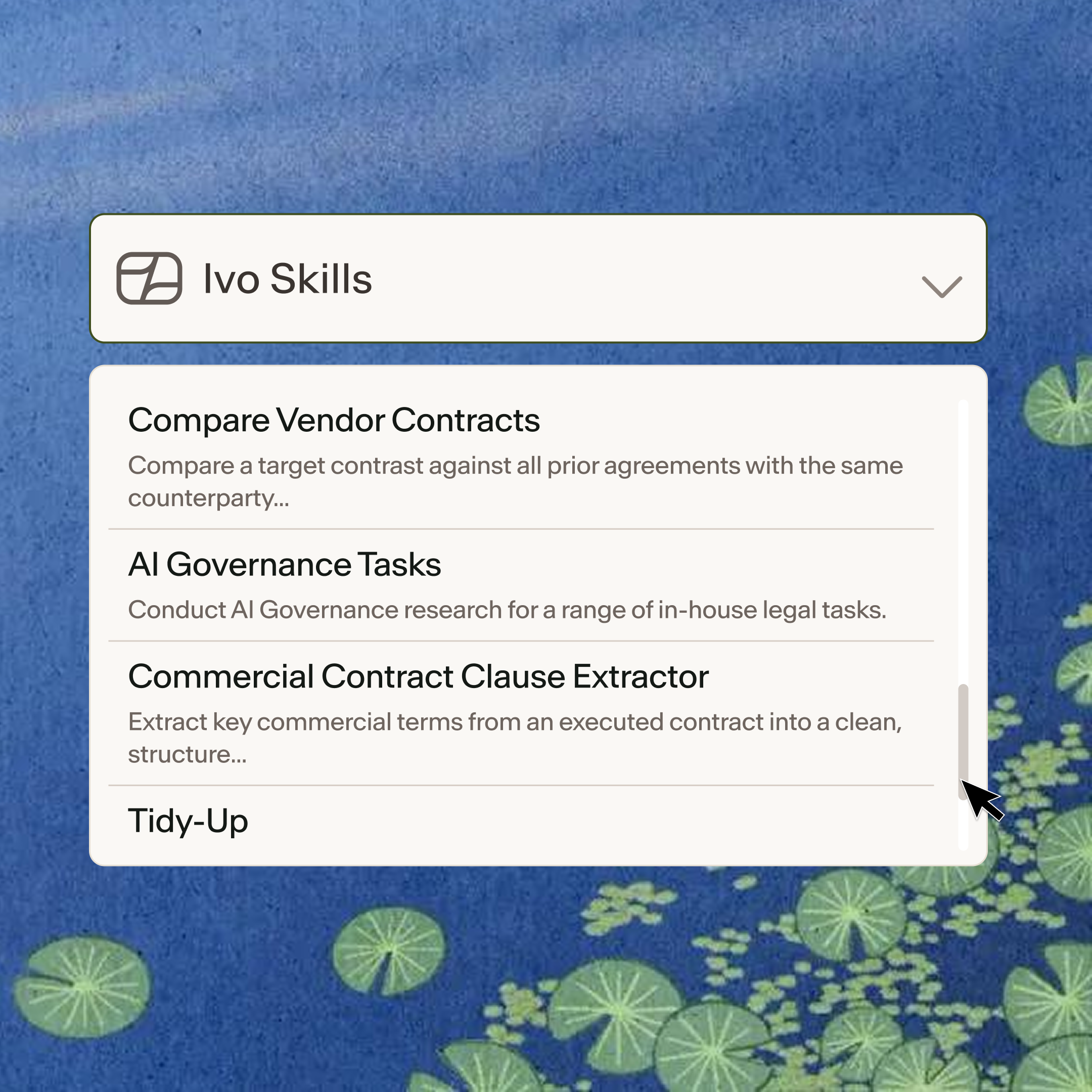
Seeing this progression of AI in practise, Ivo Intelligence, our contract intelligence product, illustrates what a contract intelligence platform is capable of when it accesses a portfolio of agreements:
- AI Fields pull any structured data points, like complex termination provisions, directly from a contract repository in real time. No manual tagging is required at all.
- Natural-language queries let teams build information tables like a CFO-ready “financial dashboard” just by requesting, in plain language, the information they need.
- Structured extraction can triage an entire portfolio of contracts against a specific standard, such as GDPR compliance, and return a sourced, step-by-step summary instead of having to undertake a manual review project.
- Relationship mapping automatically detects how amendments, novations, and statements of work relate to a main agreement, and assembles the prevailing terms into a single, current view.
- Dashboards surface portfolio-wide provision patterns like auto-renewal rates and liability caps, so institutional knowledge doesn't live only in one person's head.
The takeaway
Solving the contract visibility crisis requires the business to read its own operating system the moment it is needed, at scale, and without waiting on a manual review. The good news is that the intelligent functionality to do this now exists, meaning legal and contracting teams finally have the tools to match how much they're already expected to know about the business they support..