There’s a high chance that the contracts your team signed last quarter are already invisible to your business. While they may be stored in the cloud, in a shared folder, or in a CLM, you still can’t easily extract information from them. This is because "stored" and "findable" are two different things, and “findable" and "understandable" are even further apart.
To solve this, contracting teams have invested heavily in filing, storing, and tagging systems. However, none of these so-called solutions fix the fact that it is still extremely difficult to see what the business has already agreed to; in other words, what the contracts in these expensive storage systems actually say.
That lack of information extraction has real costs; companies need to know what their obligations are, and they rely on their legal and contracting teams to be able to quickly get them answers. If those teams can’t answer in a timely way, there’s the risk that the rest of the organization moves on, making decisions independently, without that precise contractual data. Decision-making without all the relevant information exposes the company to significant risk, which, of course, the legal department will be obligated to deal with later.
In-house legal teams are increasingly expected, and want, to be a strategically important arm of the business. They can offer informed views on crucial business matters like risk exposure, contractual leverage, and how the company's position compares to market norms. But doing so requires the ability to answer specific questions about the business's contractual positions quickly and at scale, questions such as:
These questions come up on occasions like board meetings and M&A due diligence, where legal guidance is sorely needed. Unfortunately, when legal departments can't answer these questions quickly, the business thinks they’re being slow or commercially disconnected. However, the real issue is simply that they don’t have the right tools for the job.
"Our problem is that folks can't find their contracts. They do a search and even if they filter it down, it gives them essentially everything under the sun and they're not entirely sure what's the most up-to-date contract."
Lawyers know the time cost of answering these questions when information in contracts can’t be easily found. Ivo's recent research study revealed that 80% of legal teams spend at least an hour every week manually searching inside agreements for this type of business-critical information, and 14% spend 10 hours or more: that’s a senior lawyer's entire working day, every week, spent on information retrieval rather than analysis or judgment. Every hour spent searching for contract information is an hour of a lawyer's time not spent analyzing risk, advising on a commercial decision, or helping the business think ahead. Legal teams are kept reactive by software that should be helping them to be proactive.
The root of the problem is that not very many people, and certainly not many software providers, understand just how critical contracts are to a business. Every significant commercial relationship, whether it's customers, employees, suppliers, partners, or lenders, is governed by a contract. Those contracts define what a company can and can't do, what needs to be paid and when, and what happens when things go wrong. They're the operating system that your business runs on, and if your business can’t effectively read or understand that operating system, that creates a gap between what a company has committed to and its ability to surface and act on it. That’s the real risk your business faces: one we’ve identified as a contract visibility crisis.
"Probably every big company is the same. The whole contract situation is a mess. Our CLM is a mess. We're looking at a dumpster of documents, some are linked, some are not linked, some are complete, some are not complete."
The industry has spent decades only treating the symptom of this crisis, with paper contracts being moved to filing cabinets, then to the cloud, and then to CLMs that added metadata and workflows. However, each generation made storage incrementally better without addressing the actual issue: nobody can read the contracts at scale, quickly, without manually extracting the information clause by clause.
Reading a contract the way a lawyer does (understanding concepts, following cross-references, and spotting what's unusual) used to require pure human review. However, large language models have changed that; especially since the language in contracts is precise, structured, and pattern-based, making it well-suited to be analyzed by AI.
Initially, early LLMs could produce contract-like text but couldn't reliably comprehend an existing document. The next generation of tools could answer simple questions but were prone to hallucination and lost coherence across long documents. GPT-4-class models made reviewing a single document viable, but connecting a particular clause to its implications elsewhere in the agreement still required a specific prompt telling the system where to look.
But in the last year, models have acquired the ability to conduct multi-step reasoning across long, interconnected documents. AI can now identify relationships between clauses, flag deviations from market norms without being told where to look, and treat a master agreement, its amendments, and every governed statement of work as one coherent picture.
This progression turns what once was a multi-day review of a supplier's termination rights, pricing protections, and liability caps into a query answered in minutes, with citable sources included. It lets a marketing team find which customers granted them logo rights, without getting their legal or contracting teams involved until the legal judgement stage, and lets a finance team ask which agreements carry uncapped liability and receive a downloadable table, instead of having to ask legal to make a quick, educated guess.
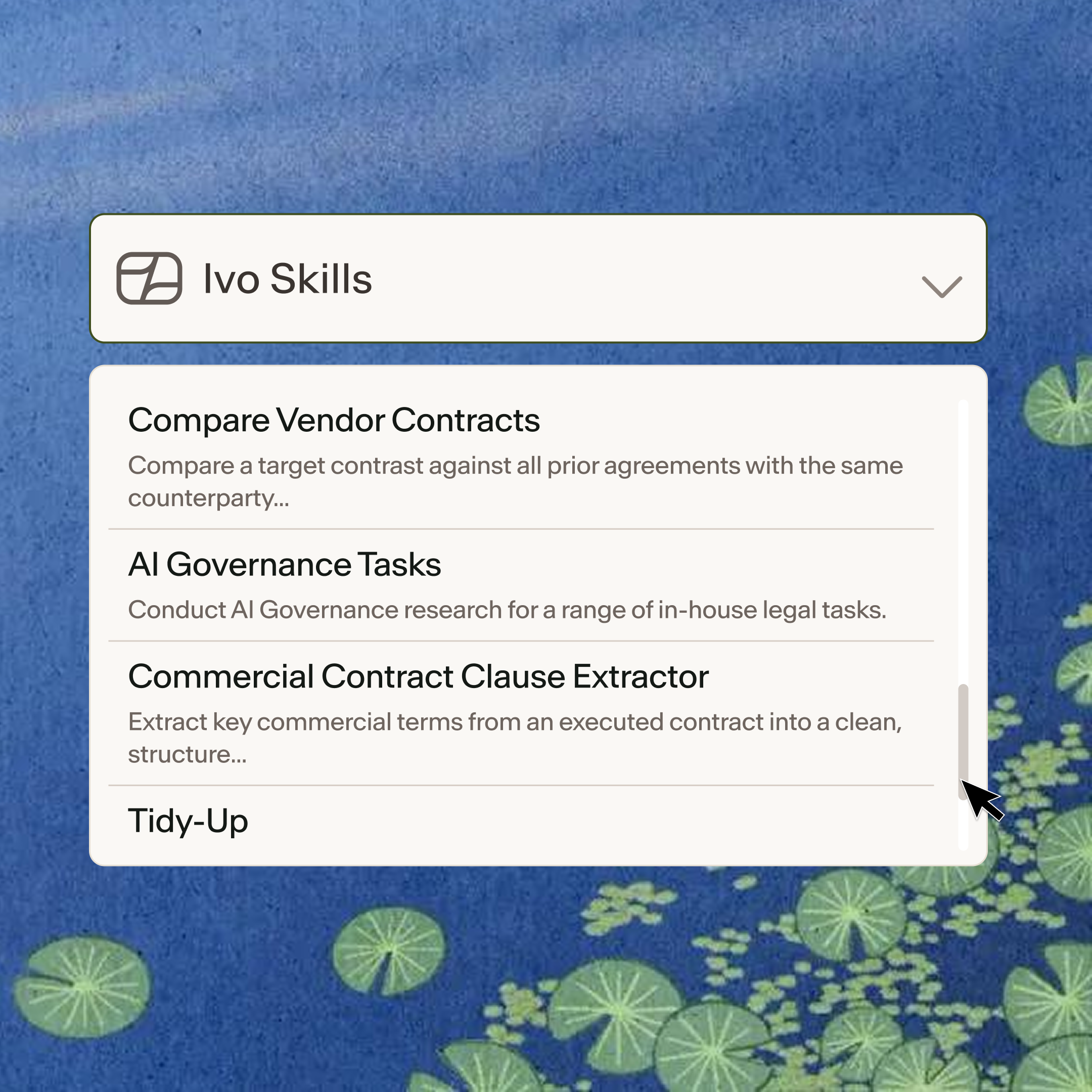
Seeing this progression of AI in practise, Ivo Intelligence, our contract intelligence product, illustrates what a contract intelligence platform is capable of when it accesses a portfolio of agreements:
Solving the contract visibility crisis requires the business to read its own operating system the moment it is needed, at scale, and without waiting on a manual review. The good news is that the intelligent functionality to do this now exists, meaning legal and contracting teams finally have the tools to match how much they're already expected to know about the business they support.
Most lawyers enter law school with a fairly clear picture of the career paths ahead. For most, their career path can go in one of two directions: they can either join a law firm, where they’ll grind as an Associate until they make Partner one day, or become an In-House Attorney. Both have their pluses and minuses, and are equally well-established pathways. Today, there is a third option: the role of Legal Engineer. The rise of AI-powered legal tech has brought with it a role that previously didn’t exist, and there’s a lot of discussion about what it is and what it means for the legal profession.
Alexis Nicholas, one of Ivo’s Legal Engineers and In-House Attorneys, believes she has seen the future.
“One of the best parts about Legal Engineering at an early-stage company is that it’s such a flexible and changeable role,” she says. Alexis describes her role as having four focus areas:
“The role will, of course, be different at different organizations, and the areas of responsibility will change based on what the business needs,” Alexis notes. “That’s what makes it so interesting and varied.”
Alexis points out that with these four different focus areas, she’s still very busy, but it’s a different, more directly rewarding form of busy than she experienced in traditional legal practice. “It’s the nature of startups,” she says. “Companies at this stage have a ‘do what it takes’ energy, which gives Legal Engineers much more scope to be creative and wear a lot of hats. Of course, there’s an infinite number of things to do, with the potential to keep doing more if you want to. But it’s a choice to be here and build, and I feel the excitement of being able to still be a lawyer and use my legal skills, but in a much more creative and novel way. It’s hugely fulfilling.”
To Alexis, one of the most important aspects of being a Legal Engineer is the energetic and resourceful culture at a startup and the immediate results she can deliver within it. “At a firm, being busy usually meant deep, narrow focus: all your hours spent becoming an expert within one practice area. But at Ivo, being busy means switching between different types of work in the same day: negotiating a contract, working on a product pitch, testing a new feature, joining a customer call, running a demo, prepping a webinar, initiating a new internal workflow; and that variety changes how the hours feel. It's less like grinding through billable hours on similar tasks, and more like constantly learning and being introduced to new directions. It’s more energizing because I can see the direct impact of what I'm doing, rather than working on a specific, siloed matter that your team has been helicoptered-in for.”
Legal Engineering is emblematic of a shift that’s happening in the legal profession: a slow but undeniable change in how the value of a lawyer’s work gets defined. Before AI, and in many legal roles, lawyers are, as Alexis puts it, “just a lawyer,” e.g., working on specific matters that lead to an outcome, whether that’s closing a deal, signing a transaction, or winning a case. The work lawyers do to achieve these outcomes is, albeit hugely important, a small part of a larger whole, generally in one area of specialization, and their relationship to the result for their client is remote at best. In-house attorneys get closer to that outcome, sitting inside the business and seeing decisions play out for their company in real time. But the work itself is still bound by traditional law: contracts, risk, compliance.
But as a Legal Engineer, Alexis gets that same privity to the business, but with a much wider remit, having exposure to types of work she wouldn’t typically get in a traditional legal role — public speaking, sales calls, demos, recruiting, marketing campaigns, product development meetings, and working with software engineers—and certainly not this early into a new position. The value Alexis brings is her judgment and legal knowledge, put to work across product, sales, and customer relationships, not just contracts. “It's a huge amount of learning, responsibility, and work that I'd never get to do as just a traditional lawyer,” Alexis notes. “I don’t see it as leaving the law at all, as not only do I still do legal work, but I’m also still embedded within the practice of law, just in a different way.”
All in all, a Legal Engineer’s role is a combination of legal and technical expertise, with a healthy dash of startup dynamism. And it isn’t going away. “We’re at a very interesting time in the world with AI,” Alexis says. “It feels like this century’s dot-com boom, and being a Legal Engineer is a huge opportunity to be at the heart of it. Legal AI is one of the fastest-growing corners of legal tech, so this hybrid legal-plus-product-plus-technical skill set will continue to be in demand.”
Do you have a legal background? Are you interested in trying out this third legal career path in tech? Check out our open roles!

Kaitlyn Menefee’s work as a Manager on Pinterest’s Commercial Legal Team supports the contracts that keep the business moving. She reviews and executes a wide variety of business agreements while being thoughtful and consistent about minimizing risk.
Before Kaitlyn and her team adopted AI, the first review of every contract required considerable time and thought, and ultimately a lot of mentally taxing context switching. “The friction lives in that gap between having to really dig in and also being asked to be very efficient,” she says, “And the pressure is always to move faster.”
She and her team were feeling that tension acutely: “Even when the work was repetitive, it wasn't quick.” Her team knew they needed to find a solution to help them review with care and accuracy and stay on top of the ever-increasing volume of work, so they chose Ivo to help them solve this challenge.
“[AI contract review] is a noisy market, but Ivo’s practicality is what made it stand out,” Kaitlyn says. “The Word add-in mattered, as did the click-to-redline experience and the fact that it’s quick to correct itself. And the support is probably the most outstanding piece. We get any issues handled right away.”
Kaitlyn also notes that Ivo feels like a product that doesn’t just demo well; it’s built for the way lawyers actually work. “Some products will take your playbook and essentially just paste it into the contract. Ivo understands context and underlying agreements and mimics how you would actually redline an agreement.”
She also appreciates that it’s easy to keep a human lawyer in the loop with Ivo. “Ivo really helps with speed and consistency when doing that difficult first pass. You can focus on the judgment calls rather than the tedious process of redlining.”
Kaitlyn shared three typical use cases where Ivo helps relieve the tedious first pass of work:
Kaitlyn needs to review complex lease agreements. During implementation, Ivo took her manual Word playbook and turned it into a playbook that can be accessed while reviewing any contract. Now, she opens the initial draft of the contract in Ivo, selects the playbook, adds any context she has about preferred positions from her business colleagues, selects the Review function, and then begins the review.
After the review runs, she’ll see recommendations that either align or don't align with the playbook. One thing that Ivo flagged was specialty alterations. She clicks on that recommendation and sees what Ivo has suggested based on her playbook.
When it comes to condemnation, Kaitlyn likes to make sure that if the property is condemned by eminent domain, she has the ability to make independent claims based on any of Pinterest's property that was condemned or any costs it incurred. Based on Pinterest’s playbook, Ivo generates redlines that cover exactly what she’s looking for.
Another type of issue Kaitlyn often encounters is that the business requests a quick summary of how a certain agreement has changed over time.
Kaitlyn uploads the documents to Assistant, then prompts it to create the document. Before she presses send, there's a magic pencil icon that turns any prompt into a much more robust, explicit version, which helps with the quality of the output.
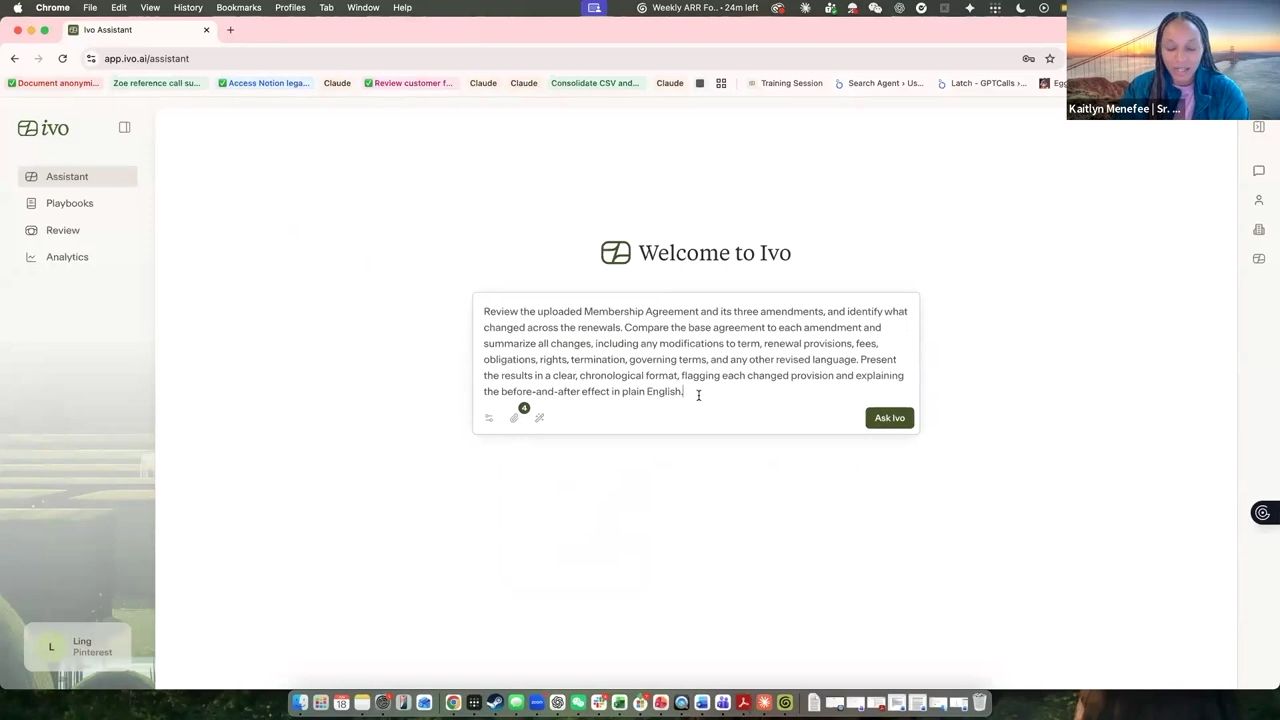
Ivo displays, across categories, what has actually changed in the agreement. Kaitlyn can say confidently what those changes are and whether the business needs to be concerned about them. And for follow-up questions, she can go to her history on the right side of the screen, open up the previous session, and ask additional questions in the conversation itself. No more hand-comparing text with highlighters and sticky notes like she used to do. She now has a downloadable summary and a table that can be checked and shared with her business partner in minutes.
A third Ivo use case that Kaitlyn uses Ivo for is a nuanced research question about different regulations cited in various agreements. Their team had been working with outside counsel on this particular deal, but this was an urgent request from the rest of the business.
It’s not always easy to convey urgency to outside counsel, and the cost can be considerable. In this instance, Kaitlyn thought Ivo’s research function might be a better fit. Her team saved money and time, and made their business partners very happy.
With Ivo’s Deep Legal Research toggled on, Kaitlyn uploaded her documents and prompted Ivo with:
"Act as an expert in New York real estate. Can you undertake some legal research to confirm that this letter waives the requirements to remove personal property from the premises for the lease, sublease, and sub-sublease, which are uploaded as underlying documents?"
“You can point [Ivo] to specific regulations, and it will tell you whether what you intend to say in the agreement is actually what you're saying, based on what it pulls from those regulations,” Kaitlyn notes.
Ivo did something she’d normally ask outside counsel to do; it checked against local regulations to confirm that the waiver is valid and enforceable. In this particular case, the draft is good as written, but Ivo flags certain things that made Kaitlyn want to take a closer look. It gives her the context she needs to decide whether they are ready to move forward with signatures or need to revise.
Ivo has had a big impact on Pinterest’s legal team, and Kaitlyn is very happy with how it’s removed a lot of the friction from her work.
She has advice for other lawyers on how to purchase the right AI legal tool for your organization: “I think you have to start from the bottom. Don’t ask, ‘what tool should we buy?" but 'do we actually know our positions? Do we have a playbook? Do we have positions we can articulate to an AI product to actually be helpful?’ Because if not, no matter what tool you select, it's not going to help you succeed. That internal alignment work is what comes first, and where you need to start.”
See more about how Pinterest uses Ivo.

Every in-house legal team negotiates the same clauses over and over again. With every signed deal, your team builds up valuable knowledge: what liability caps you've accepted; which indemnification language is standard for your industry; or how often mutual NDAs get pushed to one-sided. That history is a real competitive advantage, but almost none of it is accessible.
It lives in people's heads, buried in shared drives, or locked inside a CLM that nobody has time to search. So when a new agreement lands, you start from scratch. You track down whoever worked on a similar deal. You dig through old contracts. Or you make your best judgment call and move on.
That is, until today. What if you could access the full knowledge of your previously negotiated contracts with a single click?
Ivo Benchmarks gives your team institutional memory, inside your review workflow, at the precise moment you need it.
When you upload a contract into Ivo, Benchmarks automatically scores each clause against your history of executed agreements. Within seconds, you can see how a provision compares to similar contracts you've negotiated before, filtered by counterparty type, industry, and governing law. Then you get a clear recommendation on whether to accept or push back.
You don’t have to hunt for answers or guess the right approach anymore. Your past becomes your strength.
Point Ivo at your contracts, and Benchmarks begins its work.
Ivo evaluates each clause in the contracts you’re reviewing and compares them against your previously executed agreements. You can see how often your team has agreed to that exact provision before and what Ivo recommends based on that history.
When you want to understand why Ivo made its recommendations, you can see the exact language from your historical agreements. Then, you can pull relevant clauses from your contract library, compare and contrast them, and see the reasoning in seconds. The logic is always visible and traceable.
While Benchmarks works, a multi-step process is occurring to both retrieve the relevant documents your new contracts are being compared to and scored against. Here’s what’s happening under the hood:
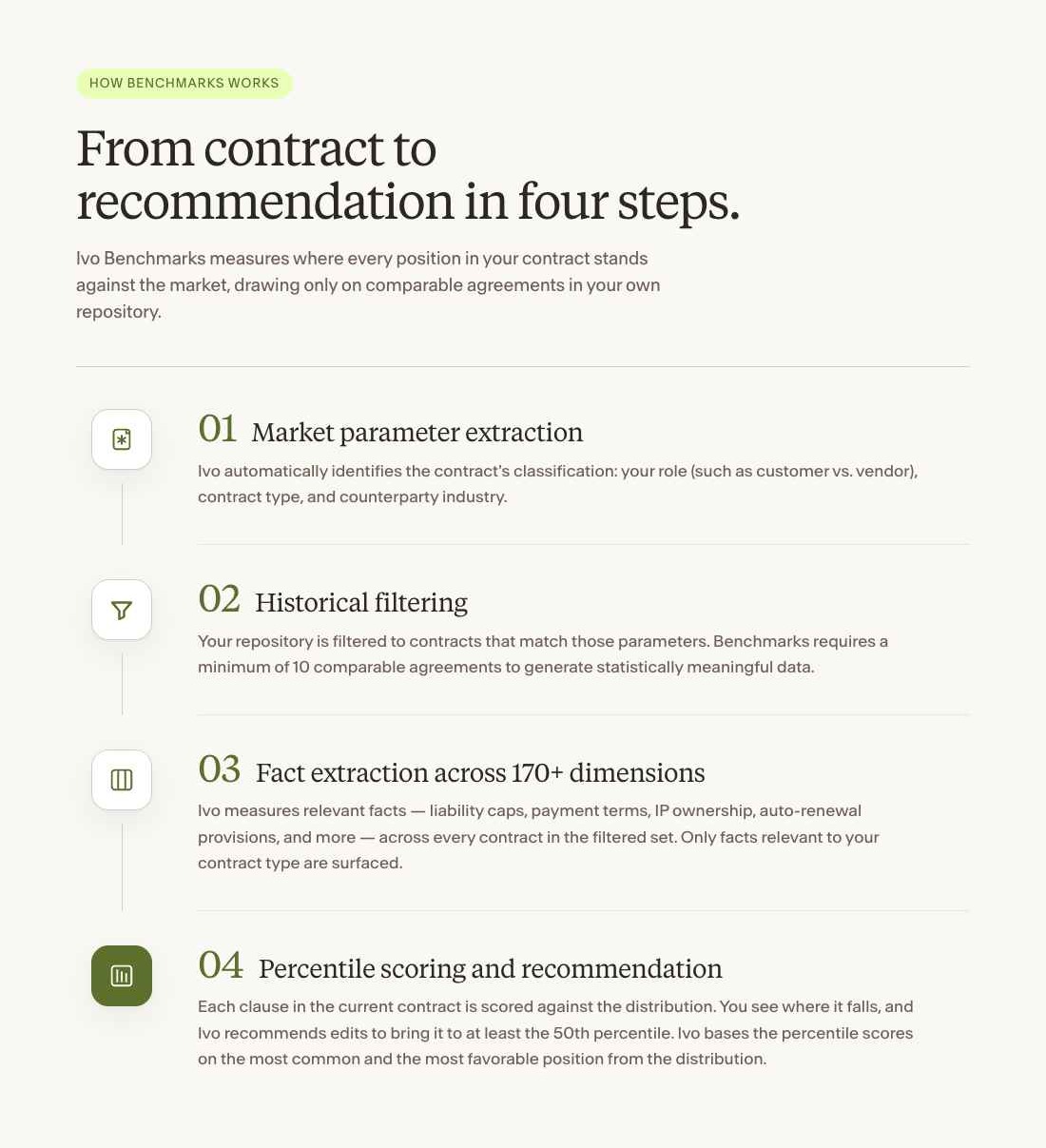
Only facts relevant to this specific contract type are surfaced. Ivo uses LLM-driven relevance filtering to skip topics that don't apply, so you're never shown a benchmark for a provision that doesn't exist in the agreement you're reviewing.
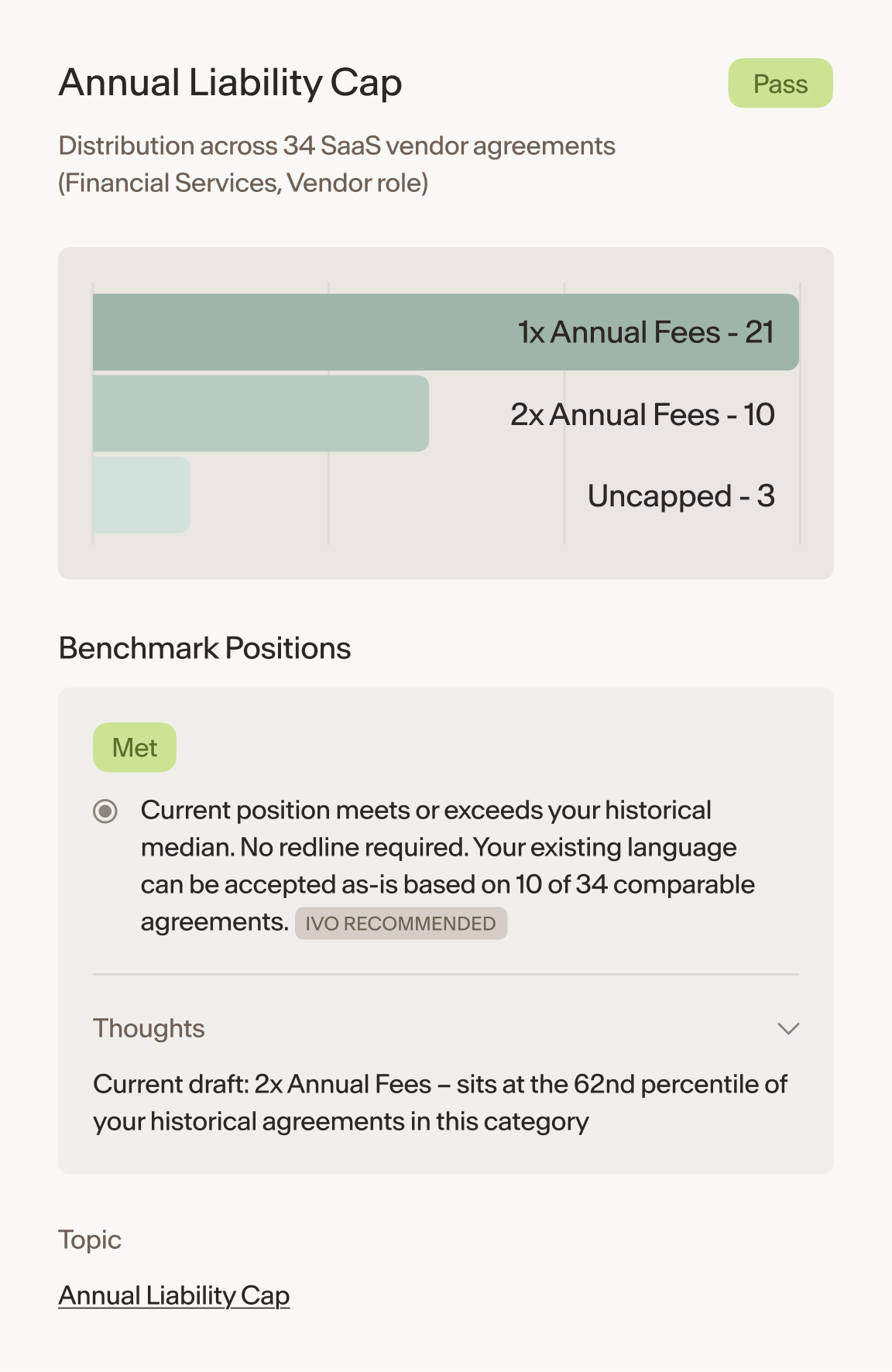
This is what Benchmarks produces when assessing annual liability caps in a SaaS agreement review.
When a provision falls below your median (for example, a counterparty is proposing uncapped liability), Benchmarks will flag it, and Ivo's review agents will draft a redline toward your 50th-percentile position, using language drawn directly from your own past agreements.
Benchmarks is most valuable when you’re reviewing high-volume agreement types where your team has built up a considerable negotiating history. Here are the patterns we see most often:
1. Vendor and SaaS MSA review
Third-party paper · Typical library: 50–300 executed agreements
Benchmarks can measure liability caps, IP ownership, data processing terms, SLA minimums, and auto-renewal windows against your history with your vendors. When a vendor proposes a mutual indemnification clause you've never accepted, Ivo will flag it with a finding like “accepted 0 of 67 times.” It will then suggest language from the agreements where you held the line.
2. Customer contract negotiation
Own paper · Typical library: 100–500 executed agreements
Benchmarks tells you how many concessions you’ve made in the past on your own paper. If a customer is pushing for a shorter term than you typically accept—say, 12 months vs your standard 24—the feature will surface a pattern like 82% of comparable deals closed at 24+ months, giving your team a data-backed position to help you respond.
3. NDA and confidentiality review
Both paper types · High volume, lower stakes per agreement
For high-volume, lower-stakes agreements like NDAs, Benchmarks is useful. Your team has signed hundreds of these; Ivo can tell you whether a one-way NDA (instead of mutual) is something you've consistently pushed back on (accepted mutual structure 91% of the time), or whether it's worth the round trip.
Benchmarks adds to your existing playbook positions; it doesn’t replace them. When a benchmark overlaps with a playbook item, the playbook position always takes precedence. Where you have playbook coverage, benchmarks add historical context, and where you don't have playbook coverage, benchmarks can fill the gap automatically, surfacing facts your team has taken positions on through hundreds of past deals.
Every benchmark recommendation shows its sources, which are the verbatim clauses from your historical agreements that define the distribution of the legal positions.
Benchmarks activates when you connect a repository of your executed agreements to Ivo. The minimum threshold is 10 comparable contracts in a given category, although most teams find meaningful benchmarks emerging around 25–50 agreements and richer distributions forming at 100+.
Once your repository is indexed, Benchmarks runs automatically on every new review. There's nothing to configure: Ivo extracts the market parameters from any agreement you review and pulls the right historical comparisons.
Benchmarks is now generally available (GA). See it in action.
Playbooks are how you tell Ivo Review your standards (e.g., the positions you take, the language you prefer, the lines you won't cross) so its redlines track to how your team actually works.
With Playbook Builder, you start from the contracts you already have. Point Ivo at the agreements in your repository, or upload from your local folders, and it will direct a few questions to you about which agreements to learn from and what to focus on. It then begins to draft the playbook from your own contracts, templates and guidance documents: standard positions, fallback language, all learned from your own precedents. You review every position in the output, choose whether it stays personal or goes to your whole organization, and save it as a playbook in a single step.
Most teams carry a long list of agreement types they've never found the time to build a playbook for at all. Now you can build those yourself, in minutes.
Every position Playbook Builder drafts comes from your own agreements, with a citation back to the contract it came from. You're never taking the output on faith as you can trace each position to the source and confirm it reflects how your team actually contracts.
Because you build it yourself in minutes, you can finally cover the agreement types your team has never gotten around to, the ones that have sat on the someday list while higher-priority work came first. More of your review runs against a real playbook instead of none.
You decide which contracts Ivo learns from and review every position before it's saved. And because creating playbooks is governed by role, administrators control who can author them and whether a playbook stays personal or becomes a company standard, so self-serve speed never costs you a single source of truth.
Playbook Builder gives your team a faster way to turn its own contracts into working playbooks, with the guardrails to keep your standards consistent. If you need any additional support building playbooks, our solutions attorneys are always here to help.
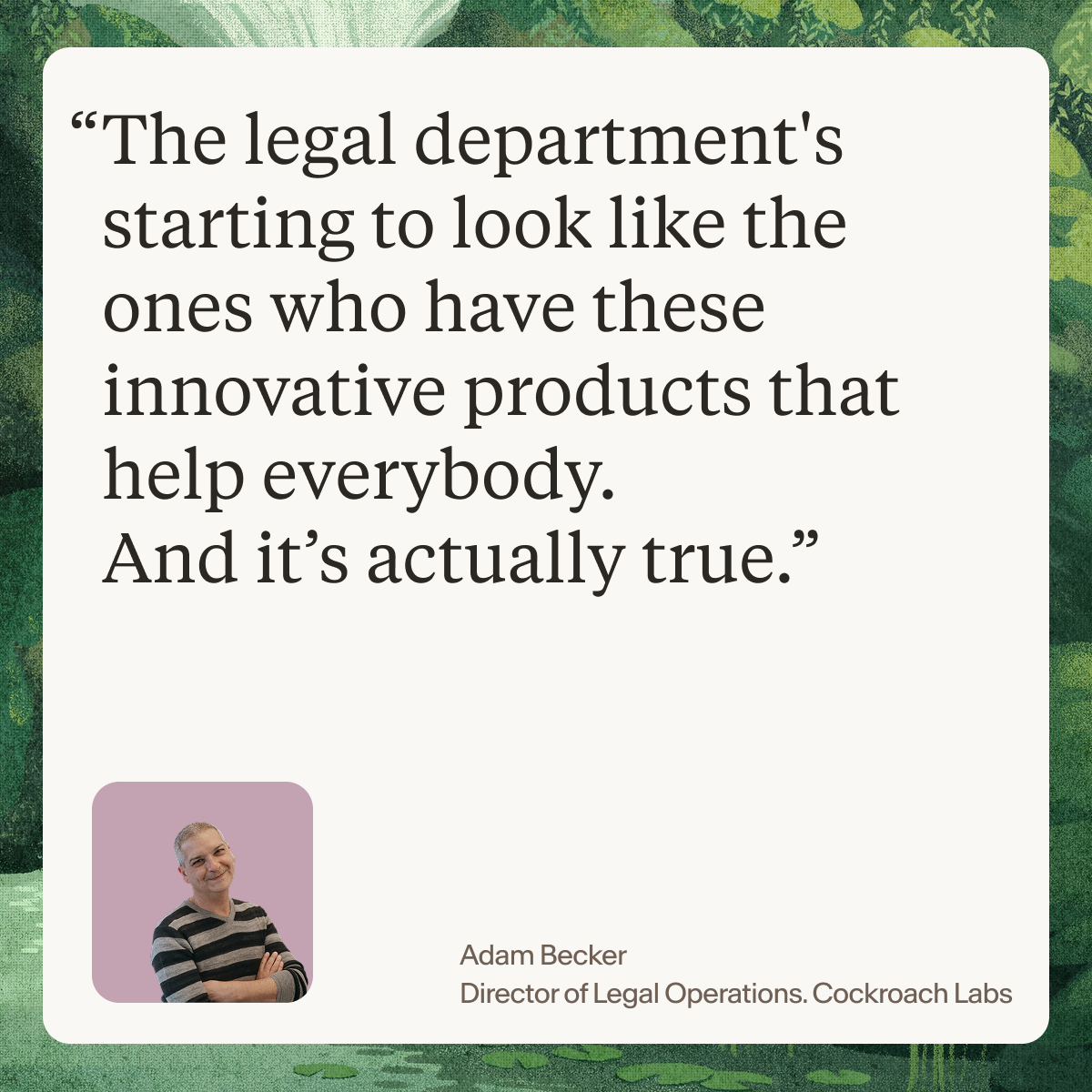
Where are your contracts right now? For many organizations, the answer is “inside a filing cabinet”— physical or digital, it doesn’t really matter which. They’re executed, archived, and consulted when something goes awry. But Adam Becker, the Director of Legal Operations at Cockroach Labs, thinks that’s about to change. And he couldn’t be more excited.
In our new series, Car Counsel, Adam describes contract intelligence as the ability to know what’s in your contracts without the manual effort that always made getting those answers so difficult. He elaborates. “[Contract intelligence is] a program that can tell you what's in your contracts without the need for traditional CLM tagging and review.” Suddenly, contracts are actually becoming useful.
Becker says that the first way many legal teams feel this shift is in moments of urgency. Perhaps a contract dispute might arise, or, as Adam notes, a global event like a pandemic makes force majeure language the most important text imaginable. You need to find that language quickly without having to sift through dozens of documents.
"If you have something that can just tell you, that's awesome, and if it's as good as a person, or close to it, that's awesome, too."But reactive retrieval is just the starting point. The more interesting question is what happens when contract data becomes proactively useful as a matter of course.
Where contract intelligence comes into its own is when legal teams can spot patterns that are valuable to the rest of the business. Becker's clearest illustration of this involves the finance team, which might want to know how many customer agreements carry 120-day payment terms. It's a reasonable business question, the kind of question that used to require a manual review project that could take weeks or months.
"That is not something that I'm particularly interested in," Becker says, "and a tool can do it for them and they can learn how to use that themselves.” Now, contracts stop being a legal artifact and start functioning as a data source. Becker imagines a world where finance, procurement, and operations can access that data themselves. The upshot is that businesses are using data, until now buried inside contracts, for actual revenue opportunities.
What Becker is describing is a different relationship between an organization and its own agreements. The intelligence was always there: buried in executed PDFs, scattered across shared drives, indexed by no one. Contract intelligence, powered by AI, makes it retrievable.
He sees this as part of a broader shift in how organizations are connecting data sources across departments to get a holistic view of all relevant data sources. "The things that we put into place should have an impact outside of legal," Becker says. That requires legal ops practitioners to think past the mechanics of contract management and into the underlying business logic. "It's not enough to say, 'Oh, they care about these five clauses in the contract, so this is how we built the flow,'" he explains. "Well, why do they care? What does it mean? What happens when it goes wrong? You need to be able to build that now."
For legal ops professionals thinking about what this moment demands of them, Becker's advice is consistent: stay curious, keep up with what leadership is being asked to do, and make sure the work you're building has reach beyond the legal team.
"We have to keep up with what our bosses are being tasked to do — figure out how we strategically support them as they are involved in more of the organization. And we should be, too.” After all, he points out, thanks to AI-powered legal technology, legal teams are now considered the center of innovation in many companies. "The legal department's starting to look like the ones who have these innovative products that help everybody," Becker says. "And it's actually true."
When considering adopting AI, legal teams often ask themselves whether they should buy a tool or build it in-house. We’ve seen the splashy stories: law firm Kirkland & Ellis, for example, is spending $500M USD to build its own AI tool. On the opposite extreme, former Latham & Watkins associate Will Chen has created MikeOSS, an open-source legal platform that claims to offer the same functionality as very well-known legal AI tools. Comments like this turn up regularly on the r/legaltech subreddit: “You can easily vibe code all of the functionality of [a major AI legal tech vendor] in a weekend. In fact, you can vibe code a better solution since you can customize it to your situation.”
So the question remains: with vibe coding tools, open-source projects, and general-purpose AI tools entering the legal market, should enterprises create their own AI tools in-house? Can you vibe code a legal AI tool that can do the work that in-house counsel needs it to do?
“You can absolutely vibe code a legal AI tool,” Didier Smith, Ivo’s Head of Engineering, says. “But whether that’s a good idea depends a great deal on who is doing the vibe coding.”
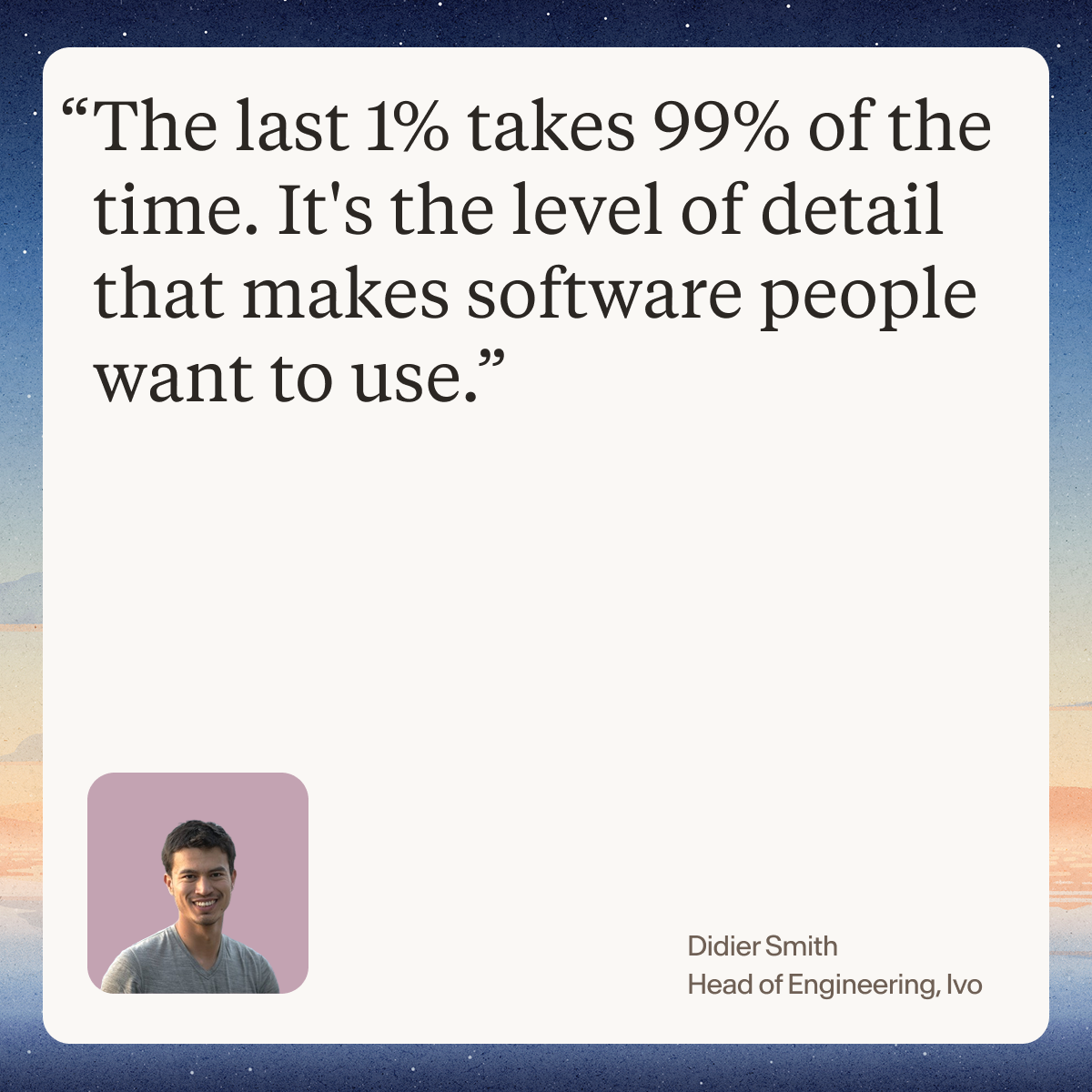
The reason, Didier points out, comes down to a software principle. “There's this rule in software called the 90/90 rule,” he notes. “Ninety percent of a software project takes 10% of the time. Then the last 10% takes the other 90% of the time. I believe that now, with AI vibe coding tools, it's actually closer to the 99.99 rule. You can get something that is 99% complete in a very short amount of time. But then that last 1% takes the other 99% of the time. It's that level of detail that makes the difference between software that normal people want to use and software that only tinkerers want to use.”
Didier notes that the best example of obsessing over this type of detail is the fate of FreeBSD, an open-source operating system that dates back to the original Unixes in the 1970s. “People have been tinkering away on FreeBSD in their spare time for about 50 years. And many people do run FreeBSD on their laptops. But they just don't know it, because Apple did the last 10%. macOS is, in fact, built on top of FreeBSD. Apple did all the bits that the guys tinkering in their spare time didn't want to do.”
The same principle applies to vibe-coded or open-source software. “People love to smash out these open-source projects when they're fired up,” Didier observes. “You go on the weekend and think: I want to build a legal AI tool, I want to build an operating system. And that first 99% is really satisfying because you just have your concept in your head and you bash it out and you've got something that sort of works. But then you run into the edge cases you didn't anticipate. The number and diversity of those edge cases determines how long you're going to be grinding away before you have something that's actually acceptable in practice.”
Didier elaborates on why the profession of law, in particular, has such a high number of edge cases. “One reason is purely technical,” he says. “Lawyers deal a lot with Word documents, and Word documents are an obscure, complex format. Lawyers care a lot about formatting—the numbers on their bullet points, the clause numbers—and those have legal implications. Getting a clause reference wrong can actually cause trouble down the line. So just editing a Microsoft Word document in a way that a lawyer would be happy with is surprisingly difficult. And then there's the legal substance itself. A lot of people think contracts are like code written in English, but that's not true. Code is designed to be unambiguous, whereas contracts are often designed to be ambiguous. Lawyers, when negotiating a contract, are under a dual tension. They have to protect their company from risk, but they also need to get the deal closed. So they'll deliberately put in ambiguous language that lets the deal move faster—language they can later fall back to arguing in court.”
Didier points out the importance of domain expertise in both engineering and law. He notes that the two professions have different skill sets, which means lawyers are unlikely to enjoy using open-source or vibe-coded software. “The people who can orchestrate agents and vibe code Claude Code instances just tend not to be the same people who know the difference between a good redline and a bad redline. This is why we have companies with different people in them and different departments—so the people who are great at programming can focus on programming, and they can leverage the domain expertise of people who are great at law.”
That said, he points out, there is some crossover between people who enjoy vibe coding and people who are good at practicing law. And in those cases, it’s possible that creating these types of software projects might be a good solution to working more efficiently. “If you're a tinkerer and you like tinkering, and you don't mind when your software kind of breaks a little bit because you can fix it, and you enjoy that, then it probably is a good idea to tinker away and build your own legal AI setup. But your average lawyer won’t want to go through the grind that it takes to build something that works really well in a high-edge-case environment. And if it breaks, the lawyers aren't going to be the ones to fix it. They're just going to say it's broken. You're not going to get the lawyer open-source community submitting PRs to your GitHub,” he jokes.
Didier is clear that none of this is a criticism of the tinkerers themselves. If you enjoy building, you should build. The question that legal leaders should ask themselves is whether these types of tools will survive contact with a legal team under pressure that has neither the time nor the inclination to scrutinize their output or fix them when they break.

Linda Evans is Senior Director, Commercial Legal & Operations at Hootsuite, and has run procurement, supported a high-volume sales organization, and sat through more vendor demos than she can count. She’s also spent the last year getting her legal team to actually use AI and has valuable insights about the experience.
Like many legal leaders at fast-moving tech companies, Linda faced an impossible math problem. The volume of work was rising, and headcounts weren’t increasing. Legal teams are being asked to absorb more work with the same amount of resources. The only answer is to innovate.
“It's part of our DNA to use software where we can. If you don't use the tools that are readily available, you won't succeed," Linda says.
Many legal leaders find themselves in a situation where they have a directive and a budget to find AI tools to streamline the workload, but they face a market full of vendors making similar promises. There’s no established roadmap of how to buy or implement an AI tool yet. So the reality is that you have to figure it out as you go, just like everyone else. And that was the experience at Hootsuite.
Linda came to vendor evaluations with a clear point of view: she knew her problem, she'd done her research, and she didn't have time for a fluffy pitch.
"You've got my time for a reason," she says. "I've done enough background research to get me in the room. Use your time wisely. Show me what you can do."
Her specific need was narrow and well-defined: faster contract review for a small legal team supporting a high-volume sales organization. She didn’t need a company-wide platform, and she didn’t want to roll out a repository that would require change management across the sales org. She wanted one thing done well for lawyers who needed to move faster.
That clarity made the evaluation process easier. She thinks having it is critical for anyone in the market for an AI tool; the best way to get what you want is to know what problem you're solving before you get to the demo. Many vendors will try to sell you more than you want. The right vendor will listen to what you actually need.
Issues that Linda had to consider, as she went through the vendor selection process, were how to mitigate the risk of non-legal professionals using AI tools for legal purposes, as well as how to ensure that the AI tools are actually trustworthy.
General-purpose AI tools are accessible to everyone in a company, and not everyone using them to review a contract knows what they don't know. Anyone could run a contract through a general AI tool and miss something a lawyer would catch. This could create risk exposure that the legal team wouldn’t know about until it's too late.
The answer, Linda says, isn't to ban the tools. It's to build the structure around them.
"That's down to having governance policies, having frameworks, educating a team," she says. "And it has to be from the top down."
Linda’s point of view is that creating these guardrails is a responsibility for leadership, not a legal ops task. It requires clear internal communication about which tools are sanctioned for which purposes, what the boundaries are, and why they exist. The legal team can write the policy, but someone at the executive level has to support it.
When you roll out an AI tool, there’s a secret no one talks about. Things will often go slower before they go faster. And that’s expected. It’s even okay.
Playbooks have to be built, lawyers have to learn to prompt, and the tool has to be trained on how your organization works. In the meantime, work still comes in, and timelines don't shift. It’s a significant ask for a lawyer who is already under pressure to do something the harder way, on purpose, even just temporarily. That’s the situation Linda found herself in.
"In the beginning, the lawyers told me, it's taking us longer," Linda recalls. "And I said, I understand, because you're training it."
If she had the chance to do it again, she’d make a deliberate space in the implementation schedule for that period, and she’d plan it with intention. There might be a structured onboarding roadmap rather than an open-ended expectation that people would learn the tool themselves. There would be dedicated weekly training sessions with the team. There should be a realistic conversation upfront with her team about what the first few months would actually look like.
"Nothing is plug and play," she says. "Nothing is out of the box and immediately you've got an ROI. There is a real time involved in this. And you have to put the time in yourself upfront."
The teams that go through this bumpy introduction period are the ones who actually get value out of the tool. The ones who don't plan for it often wonder why adoption is low, and face renewal conversations they're not ready to have.
The single most important factor in whether a legal team actually adopts an AI tool is whether their leader is willing to use it.
"How can anyone buy into doing something differently if you're not doing it yourself?" Linda points out. "Change comes from the top. You have to walk the walk."
Linda notes that she doesn't ask her team to do things she won't do herself; she models the behavior she wants to see. Not only does she use AI, she shares results in the team Slack channel so everyone can see what she’s doing. To make AI adoption actually stick, the leaders have to be visibly, consistently in the tool alongside everyone else.
The roadmap for adopting AI is still nebulous. But Linda’s experience shows that the teams that are using AI well, with the adoption to show for it, are the ones that treated it as a way to think about changing behavior and ways of working, not as a pure technology problem. People use technology, and understanding how they work and what they need will make its adoption easier and the investment more valuable.
.jpeg)
When Ivo was founded in Auckland, the ambition was clear: take it to the world and win.
Ivo is proud to announce a partnership with New Zealand Football as the Official Legal AI Partner of the All Whites, New Zealand's men's national team.
Founded in New Zealand and now headquartered in San Francisco, Ivo has spent the last several years building an AI-powered contract intelligence platform for the world's most dynamic organizations, including Meta, Uber, IBM, Shopify, and Mitsubishi Electric. Ivo has increased ARR sixfold and recently opened offices in London and New York.
"As a New Zealand-founded company, we know what it takes to build something and take it to the world stage," said Min-Kyu Jung, CEO and co-founder of Ivo. "Standing with New Zealand Football as they prepare for one of the most significant moments in the program's history is something we're really proud of."
Ivo branding will appear on the front of the All Whites' training and press kit as the team prepares for international competition, as well as across select New Zealand Football initiatives. New Zealand Football will use Ivo's contract intelligence platform to draft, review, and analyze agreements across all their teams.
For New Zealand Football, the partnership is a natural fit. "Ivo is a real Kiwi success story of a company taking on the world, and that's exactly what we strive to do every time our national teams step onto the field," said Andrew Pragnell, Chief Executive of New Zealand Football. "It's exciting to partner with a New Zealand-founded company experiencing strong global growth while remaining connected to its roots."
We're excited to support the All Whites as they take the field.
Connect with us now to learn how we can streamline your contract review process