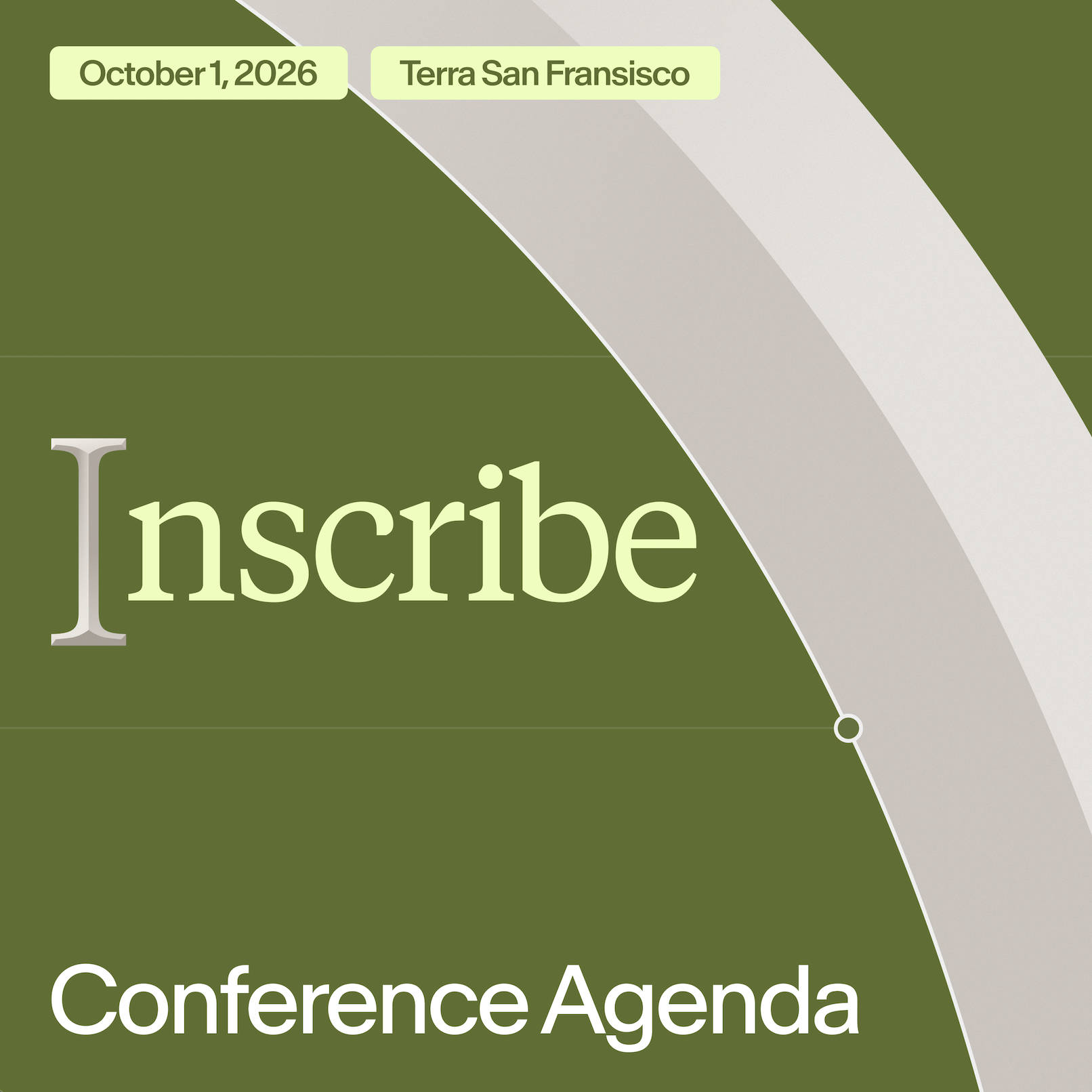
Ivo's first user conference Inscribe will take place on October 1st, 2026 in San Francisco. One day, ten sessions across two tracks, plus an opening keynote and two fireside conversations.
The Strategic Track explores the bigger questions facing legal teams today. The Practice Track looks at how to put those ideas to work. Attendees can mix and match sessions from either one.
Here's the full day.
9:00–9:30 a.m.
Our CEO and co-founder will open the conference with a special keynote address. Companies measure almost everything they do, and then leave the contract portfolio — the record of every promise made and every dollar owed — largely unread. This is the case for changing that, and for what it means when contracts start informing how a business actually runs.
9:30–10:00 a.m. — AI transformation and the future of legal and contracting
Our CEO stays on stage with the chief legal officer of one of the world's largest software companies, whose team is responsible for making sure the AI their company ships is fast, secure, and something customers can trust. That's the problem most of this room is working on now, from one side or another. The conversation is about where contracting goes as AI takes on more of the work, and what legal owns as it does.
10:30–11:15 a.m. — In-house counsel on how to go from reviewing decisions to making them
For a long time, legal was where decisions went to get checked, not made. That's changing. The strongest teams are moving upstream, shaping strategy early instead of reacting to it late. This panel brings together senior legal leaders who've made that shift, speaking candidly about how legal stops being a gate and starts becoming a strategic partner.
11:25 a.m.–12:10 p.m. — Legal leaders on how to use contract data to inform business strategy
Companies measure their sales down to the lead, track finance to the cent, and instrument operations end to end — and then leave the contract portfolio, the full record of every promise made and every dollar owed, largely unread. This session makes the case for contract intelligence as a genuine source of business insight, and for legal's role in surfacing answers that procurement, finance, and sales ops keep coming to ask for.
1:45–2:30 p.m. — Former lawyers on the transition out of practice and the future of legal work
A law degree opens more doors than most people expect. This session brings together people who trained and practiced as lawyers and have since moved into other functions, from legal engineering to marketing and beyond, to talk about the paths they took, the skills that carried over, and how they think about a legal career in a moment when the work itself is changing. Part career conversation, part look at where legal talent is headed next.
2:40–3:25 p.m. — Legal ops leaders on how they uplevel their work with AI in a changing industry
Legal ops has grown from a nice-to-have into the engine that keeps a modern legal team running, and no two functions look alike. This panel brings together legal ops leaders across different stages and segments to compare notes on what they own, what they automate, where they can add the most value, and how the role is changing as AI reshapes the work.
10:30–11:15 a.m. — Contract ops leaders on going from successful AI pilot to org-wide use
Many companies have the exact same experience: pilot goes well and a few people become power users, then use stalls for months. The issue is rarely the technology itself; it's the work of shifting how a team operates day to day. This session is a candid conversation about moving a group from curiosity to a completely new way of working: finding the internal champions who carry adoption further than any mandate, setting expectations that hold once the novelty fades, and bringing skeptics along without slowing the people already moving.
12:00–12:35 p.m. — Legal experts on crafting playbooks that become practice
Every legal team has a playbook, and most of them exist in a document nobody opens after onboarding. The gap between the standard that was written and the one your team applies at 6 p.m. on a Friday is where potential risk compounds. This session gets into the craft of building playbooks that hold up under real deal pressure: clear enough to follow, current even as the business shifts, and applied consistently across reviewers and review cycles.
1:45–2:30p.m. — Building an AI platform that serves the global enterprise with Ivo's Head of Engineering
Our Head of Engineering on what it takes to build a legal AI platform that's both reliable and rigorous enough for the world's largest companies. A few years ago, Ivo was a small startup. Today, it runs contract work for some of the biggest enterprises in the world. That process required solving hard problems most users never see: scaling to millions of contracts, keeping everything secure and fast, and turning a promising prototype into infrastructure a global legal team can rely on. He walks through what the process required, what bets paid off, and how Ivo became what it is today.
2:40–3:25 p.m. — Bring the problem you're stuck on and watch our legal engineering team work it out in real time
A hands-on breakout with no slides and no script. Bring the problems you're actually stuck on, and our legal engineering team will work through them live with Ivo, breaking down the process as they go. Part workshop, part problem-solving session, this session is a chance to see how others in the room would approach the same challenge.
4:15–5:00 p.m. — Lessons learned from company hypergrowth and a thousand enterprise AI rollouts
Our VP of Partnerships closes the day with someone who joined a frontier AI lab as its first commercial hire, back when the sales team was two people and the product everyone now uses didn't exist. She spent the next three years building the commercial organization behind it, and watching a thousand enterprises attempt their own version of the same change. She's now a General Partner at a venture firm investing in what she calls the second wave of AI. If you want to know what moves enterprise AI adoption and what stalls it, this is the conversation.
A Genius Bar with Ivo experts on hand to answer any and all questions about the product, a Feature Request Board where people can share ideas for new features and upvote their favorites, and a reception from 5 to 7 p.m. once the sessions are done.
Thursday, October 1st, 2026 Terra Gallery, 511 Harrison Street, San Francisco Registration opens at 8:00 a.m., sessions end at 5:00 p.m., reception until 7:00 p.m.

Contracts touch every part of the business, but the process around them is scattered. A request comes in over email. A draft lives on someone's desktop. Approvals happen in Slack. Finance flags a term three weeks late, and which “final” version is the right one is anyone's guess.
The work that actually decides a deal—the negotiation—has never had a system built to run it. So every new deal starts over from scratch. You chase down whoever worked on the last one like it, dig through old threads to see where things stand, or take a guess with your best judgment and push forward. Meanwhile the deal slows, and the intelligence that could have been created along the way—every position taken and concession made—disappears the moment the ink dries.
We at Ivo wondered: what if the whole process ran in one place, and every negotiation made the next one smarter?
Collaborate orchestrates the entire contracting lifecycle, from intake through approval, negotiation, and signature. It reads every agreement as it arrives, routes it based on the risk you define, and keeps every version, approval, and decision in one place.
And because the negotiation is finally running in one system, Collaborate learns from it. The back-and-forth where deals are won or delayed becomes intelligence your team retains and uses for the next one.
Collaborate is the layer between the deal and the signature. Where a traditional CLM routes documents based on inflexible rules and blind to what's inside them, Collaborate reads each agreement and runs the process around it.
Most contract work starts with a bottleneck right out of the gate: someone in the business needs an agreement, so they email legal and wait.
With Collaborate, intake is self-serve. Business users can start a deal request themselves, from the systems they already use, either by creating an agreement from a template or uploading one from the counterparty. Collaborate reads each document as it arrives, detects the type, extracts the relevant information, assesses its risk against your playbooks, links it to the opportunity in your CRM, and routes it to the right person.
There are no forms to fill and no fields to tag. Your team then confirms what Collaborate found, instead of keying it in by hand.
Traditional systems route documents on rules someone set up in advance, with no sense of what's actually in the agreement. Collaborate routes based on the risk it actually finds and you only need to set the rules once, in plain language.
Low-risk agreements can move straight to signature. Anything that needs judgment goes to the right reviewer first, with the context ready and waiting for them. Every guardrail is yours to configure: you decide what "low" and "high" risk mean for your organization, so speed never comes at the cost of accuracy or control.
This is the shift the most sophisticated legal teams are already making. Rather than reading every line of every agreement, these teams simply set the rules and let the tool run.
Once a deal is in motion, Collaborate lets the whole process live in one single place.
Legal, sales, finance, and the counterparty can all work from the same deal, with every version and approval tracked beside it. The full history is right there: who changed what, who approved it, and where it stands today. The answer to "where are we on this" is on the screen, not forensically reconstructed from a weeks-old email thread.
Because the negotiation runs in one place, it becomes something you can learn from. Collaborate can answer questions legal could never answer before, like:
Over time, Collaborate can make proactive recommendations on how to update your playbooks, based on how your organization has negotiated before. Every deal you close teaches the next one.
We built Collaborate because our most sophisticated customers already work this way: their lawyers proactively write the rules that govern risk across the whole portfolio, rather than reviewing each agreement on its own and in a vacuum. That is the shift that Collaborate is built for: putting legal’s invaluable insight and expertise at the center of every deal the business makes.
With Collaborate, Ivo now covers the full contracting lifecycle, from intake and negotiation through approval and signature, alongside Ivo Intelligence, Ivo Review, and Ivo Assistant.
Ivo Collaborate is in early access today, with general availability later this year. Join the waitlist to be among the first enterprise legal teams to run their deals on Collaborate. If you'd like help getting your team set up, our solutions attorneys are here to help.

Earlier this month, Caitlan Rocha, Ivo’s In-House Counsel, led a roundtable of general counsel at The L Suite’s 2026 Legal AI Conference. A few years ago, the conversation around AI in legal centered on one question: Will it replace lawyers? Today, that debate has largely disappeared.
Instead, legal leaders from industries like financial services, healthcare, tech, and media spent the session discussing something much more immediate: how to leverage AI to keep pace with an ever-growing volume of legal work while protecting their organizations.
The conversation Caitlan led centered on how fast the work is piling up, and how thin legal teams are stretched trying to keep pace. Several leaders described feeling buried under the sheer volume of work.
It's not hard to understand why. Like we often say at Ivo, everything starts with an agreement. You can't hire an employee, purchase software, engage a vendor, or sell a product without a contract. And as companies grow, so does the number of counterparties they manage.
Ironically, many of the technologies companies adopt to become more efficient generate even more contracts to review. Every new software category brings new vendors. Every vendor relationship comes with its own MSA, NDA, security review, data processing agreement, and procurement process.
Legal teams are left trying to solve an impossible equation: workloads continue to grow while resources largely don't. At the same time, every function around them increasingly assumes AI has already solved the problem.
At this point, most legal leaders have moved beyond asking whether AI can help. They know it can. Many organizations have even mandated AI adoption to improve productivity across the business.
But for legal and compliance leaders, the challenge isn't whether to use AI; it's how to do so responsibly.
“A number of them told me they felt like they were building the plane while flying it,” Caitlan says.
“We all follow the few relatively clear boundaries that have emerged: don't cite a case that doesn't exist, don't upload privileged documents to a public chatbot.” Beyond that, there are few established standards, and no clear timeline for when a comprehensive governance framework will emerge.
While AI regulation continues to evolve, there is still no comprehensive governance framework that answers many of the practical questions legal teams face every day, including how contract data should move through AI systems, what governance looks like in practice, or what "good" AI adoption actually looks like.
For companies in regulated industries, that uncertainty shapes every evaluation. Legal teams aren't just deciding whether a tool is valuable. They're documenting why its use is appropriate, how risks are mitigated, and how those decisions can be defended as regulatory expectations continue to evolve.
Because there are so few governance frameworks in place, companies have established their own AI governance policies, but many were written out of an abundance of caution and are too rigid to reflect the actual work employees need to do—a direct clash with employer AI mandates.
As a result, employees, including lawyers, are working around those policies already simply to keep up with the workloads they're expected to manage. Many companies are now rewriting their AI policies because the first draft didn’t reflect how people needed to work.
If there was one reassuring takeaway from the discussion, it was that no one is navigating these challenges alone. Every company is grappling with the same AI growing pains: balancing innovation with security, and productivity with governance.
Staying at the forefront of technology while trying to stay compliant and secure is incredibly difficult.
“Nobody in the room claimed to have the answer,” Caitlan says. “What they had in common was the recognition that they're adopting AI to deal with the increased workload, but they’re doing so without the familiar guardrails, decades of precedent, or fully developed governance frameworks to demonstrate they’re doing it correctly.”
That may be the biggest shift of all.
The conversation is no longer about whether AI will replace lawyers. It's about how lawyers can thoughtfully adopt AI to better support their businesses while building governance that will stand the test of time.
There isn't a tidy ending yet. The technology is evolving faster than the rules, and every legal department is learning in real time. But if the roundtable made one thing clear, it's that legal leaders aren't trying to solve these questions in isolation. They're sharing experiences, comparing approaches, and learning from one another because, for now, that's how the profession moves forward.
There’s a high chance that the contracts your team signed last quarter are already invisible to your business. While they may be stored in the cloud, in a shared folder, or in a CLM, you still can’t easily extract information from them. This is because "stored" and "findable" are two different things, and “findable" and "understandable" are even further apart.
To solve this, contracting teams have invested heavily in filing, storing, and tagging systems. However, none of these so-called solutions fix the fact that it is still extremely difficult to see what the business has already agreed to; in other words, what the contracts in these expensive storage systems actually say.
That lack of information extraction has real costs; companies need to know what their obligations are, and they rely on their legal and contracting teams to be able to quickly get them answers. If those teams can’t answer in a timely way, there’s the risk that the rest of the organization moves on, making decisions independently, without that precise contractual data. Decision-making without all the relevant information exposes the company to significant risk, which, of course, the legal department will be obligated to deal with later.
In-house legal teams are increasingly expected, and want, to be a strategically important arm of the business. They can offer informed views on crucial business matters like risk exposure, contractual leverage, and how the company's position compares to market norms. But doing so requires the ability to answer specific questions about the business's contractual positions quickly and at scale, questions such as:
These questions come up on occasions like board meetings and M&A due diligence, where legal guidance is sorely needed. Unfortunately, when legal departments can't answer these questions quickly, the business thinks they’re being slow or commercially disconnected. However, the real issue is simply that they don’t have the right tools for the job.
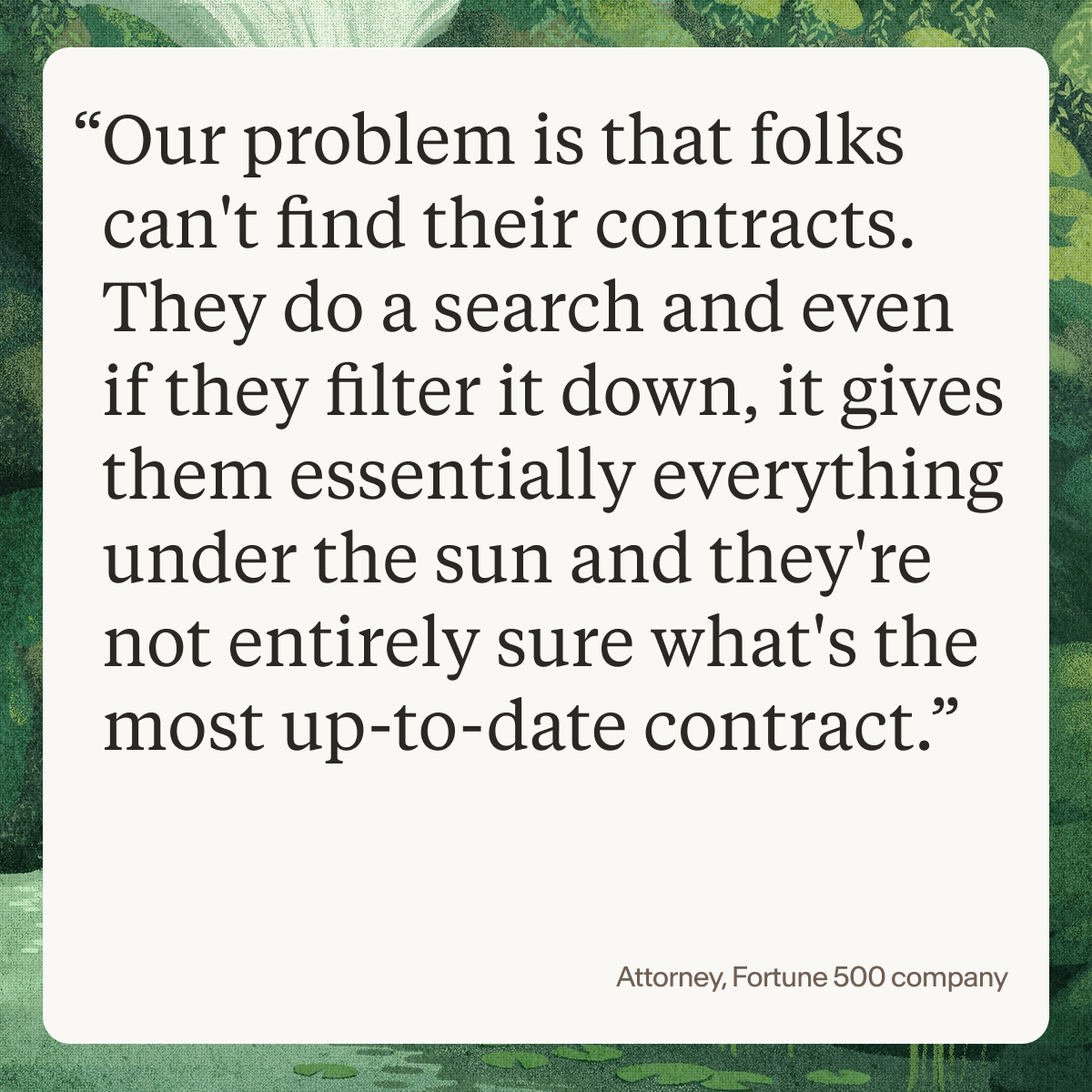
"Our problem is that folks can't find their contracts. They do a search and even if they filter it down, it gives them essentially everything under the sun and they're not entirely sure what's the most up-to-date contract."
Lawyers know the time cost of answering these questions when information in contracts can’t be easily found. Ivo's recent research study revealed that 80% of legal teams spend at least an hour every week manually searching inside agreements for this type of business-critical information, and 14% spend 10 hours or more: that’s a senior lawyer's entire working day, every week, spent on information retrieval rather than analysis or judgment. Every hour spent searching for contract information is an hour of a lawyer's time not spent analyzing risk, advising on a commercial decision, or helping the business think ahead. Legal teams are kept reactive by software that should be helping them to be proactive.
The root of the problem is that not very many people, and certainly not many software providers, understand just how critical contracts are to a business. Every significant commercial relationship, whether it's customers, employees, suppliers, partners, or lenders, is governed by a contract. Those contracts define what a company can and can't do, what needs to be paid and when, and what happens when things go wrong. They're the operating system that your business runs on, and if your business can’t effectively read or understand that operating system, that creates a gap between what a company has committed to and its ability to surface and act on it. That’s the real risk your business faces: one we’ve identified as a contract visibility crisis.
"Probably every big company is the same. The whole contract situation is a mess. Our CLM is a mess. We're looking at a dumpster of documents, some are linked, some are not linked, some are complete, some are not complete."
The industry has spent decades only treating the symptom of this crisis, with paper contracts being moved to filing cabinets, then to the cloud, and then to CLMs that added metadata and workflows. However, each generation made storage incrementally better without addressing the actual issue: nobody can read the contracts at scale, quickly, without manually extracting the information clause by clause.
Reading a contract the way a lawyer does (understanding concepts, following cross-references, and spotting what's unusual) used to require pure human review. However, large language models have changed that; especially since the language in contracts is precise, structured, and pattern-based, making it well-suited to be analyzed by AI.
Initially, early LLMs could produce contract-like text but couldn't reliably comprehend an existing document. The next generation of tools could answer simple questions but were prone to hallucination and lost coherence across long documents. GPT-4-class models made reviewing a single document viable, but connecting a particular clause to its implications elsewhere in the agreement still required a specific prompt telling the system where to look.
But in the last year, models have acquired the ability to conduct multi-step reasoning across long, interconnected documents. AI can now identify relationships between clauses, flag deviations from market norms without being told where to look, and treat a master agreement, its amendments, and every governed statement of work as one coherent picture.
This progression turns what once was a multi-day review of a supplier's termination rights, pricing protections, and liability caps into a query answered in minutes, with citable sources included. It lets a marketing team find which customers granted them logo rights, without getting their legal or contracting teams involved until the legal judgement stage, and lets a finance team ask which agreements carry uncapped liability and receive a downloadable table, instead of having to ask legal to make a quick, educated guess.
Seeing this progression of AI in practise, Ivo Intelligence, our contract intelligence product, illustrates what a contract intelligence platform is capable of when it accesses a portfolio of agreements:
Solving the contract visibility crisis requires the business to read its own operating system the moment it is needed, at scale, and without waiting on a manual review. The good news is that the intelligent functionality to do this now exists, meaning legal and contracting teams finally have the tools to match how much they're already expected to know about the business they support..
Most lawyers enter law school with a fairly clear picture of the career paths ahead. For most, their career path can go in one of two directions: they can either join a law firm, where they’ll grind as an Associate until they make Partner one day, or become an In-House Attorney. Both have their pluses and minuses, and are equally well-established pathways. Today, there is a third option: the role of Legal Engineer. The rise of AI-powered legal tech has brought with it a role that previously didn’t exist, and there’s a lot of discussion about what it is and what it means for the legal profession.
Alexis Nicholas, one of Ivo’s Legal Engineers and In-House Attorneys, believes she has seen the future.
“One of the best parts about Legal Engineering at an early-stage company is that it’s such a flexible and changeable role,” she says. Alexis describes her role as having four focus areas:
“The role will, of course, be different at different organizations, and the areas of responsibility will change based on what the business needs,” Alexis notes. “That’s what makes it so interesting and varied.”
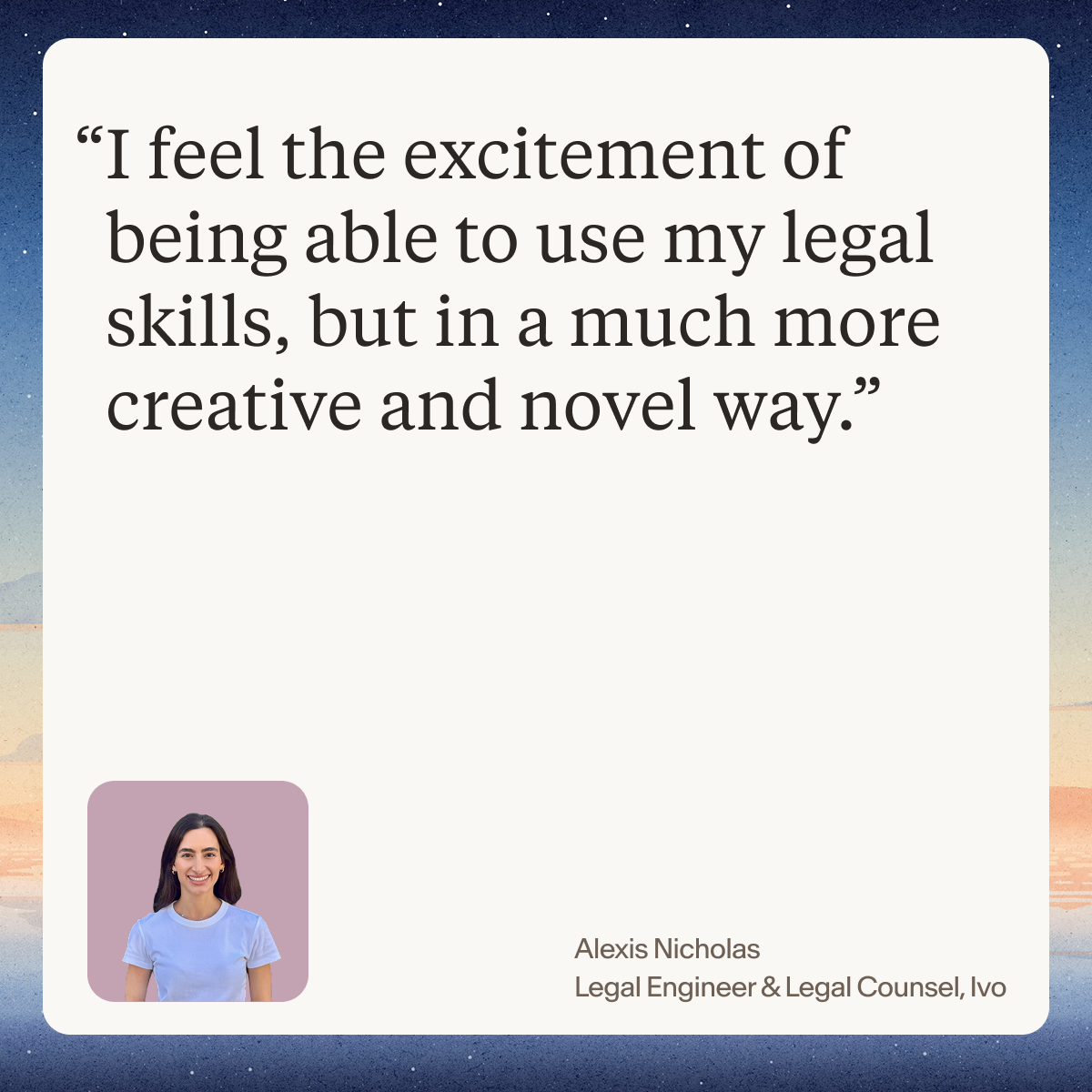
Alexis points out that with these four different focus areas, she’s still very busy, but it’s a different, more directly rewarding form of busy than she experienced in traditional legal practice. “It’s the nature of startups,” she says. “Companies at this stage have a ‘do what it takes’ energy, which gives Legal Engineers much more scope to be creative and wear a lot of hats. Of course, there’s an infinite number of things to do, with the potential to keep doing more if you want to. But it’s a choice to be here and build, and I feel the excitement of being able to still be a lawyer and use my legal skills, but in a much more creative and novel way. It’s hugely fulfilling.”
To Alexis, one of the most important aspects of being a Legal Engineer is the energetic and resourceful culture at a startup and the immediate results she can deliver within it. “At a firm, being busy usually meant deep, narrow focus: all your hours spent becoming an expert within one practice area. But at Ivo, being busy means switching between different types of work in the same day: negotiating a contract, working on a product pitch, testing a new feature, joining a customer call, running a demo, prepping a webinar, initiating a new internal workflow; and that variety changes how the hours feel. It's less like grinding through billable hours on similar tasks, and more like constantly learning and being introduced to new directions. It’s more energizing because I can see the direct impact of what I'm doing, rather than working on a specific, siloed matter that your team has been helicoptered-in for.”
Legal Engineering is emblematic of a shift that’s happening in the legal profession: a slow but undeniable change in how the value of a lawyer’s work gets defined. Before AI, and in many legal roles, lawyers are, as Alexis puts it, “just a lawyer,” e.g., working on specific matters that lead to an outcome, whether that’s closing a deal, signing a transaction, or winning a case. The work lawyers do to achieve these outcomes is, albeit hugely important, a small part of a larger whole, generally in one area of specialization, and their relationship to the result for their client is remote at best. In-house attorneys get closer to that outcome, sitting inside the business and seeing decisions play out for their company in real time. But the work itself is still bound by traditional law: contracts, risk, compliance.
But as a Legal Engineer, Alexis gets that same privity to the business, but with a much wider remit, having exposure to types of work she wouldn’t typically get in a traditional legal role — public speaking, sales calls, demos, recruiting, marketing campaigns, product development meetings, and working with software engineers—and certainly not this early into a new position. The value Alexis brings is her judgment and legal knowledge, put to work across product, sales, and customer relationships, not just contracts. “It's a huge amount of learning, responsibility, and work that I'd never get to do as just a traditional lawyer,” Alexis notes. “I don’t see it as leaving the law at all, as not only do I still do legal work, but I’m also still embedded within the practice of law, just in a different way.”
All in all, a Legal Engineer’s role is a combination of legal and technical expertise, with a healthy dash of startup dynamism. And it isn’t going away. “We’re at a very interesting time in the world with AI,” Alexis says. “It feels like this century’s dot-com boom, and being a Legal Engineer is a huge opportunity to be at the heart of it. Legal AI is one of the fastest-growing corners of legal tech, so this hybrid legal-plus-product-plus-technical skill set will continue to be in demand.”
Do you have a legal background? Are you interested in trying out this third legal career path in tech? Check out our open roles!

Every in-house legal team negotiates the same clauses over and over again. With every signed deal, your team builds up valuable knowledge: what liability caps you've accepted; which indemnification language is standard for your industry; or how often mutual NDAs get pushed to one-sided. That history is a real competitive advantage, but almost none of it is accessible.
It lives in people's heads, buried in shared drives, or locked inside a CLM that nobody has time to search. So when a new agreement lands, you start from scratch. You track down whoever worked on a similar deal. You dig through old contracts. Or you make your best judgment call and move on.
That is, until today. What if you could access the full knowledge of your previously negotiated contracts with a single click?
Ivo Benchmarks gives your team institutional memory, inside your review workflow, at the precise moment you need it.
When you upload a contract into Ivo, Benchmarks automatically scores each clause against your history of executed agreements. Within seconds, you can see how a provision compares to similar contracts you've negotiated before, filtered by counterparty type, industry, and governing law. Then you get a clear recommendation on whether to accept or push back.
You don’t have to hunt for answers or guess the right approach anymore. Your past becomes your strength.
Point Ivo at your contracts, and Benchmarks begins its work.
Ivo evaluates each clause in the contracts you’re reviewing and compares them against your previously executed agreements. You can see how often your team has agreed to that exact provision before and what Ivo recommends based on that history.
When you want to understand why Ivo made its recommendations, you can see the exact language from your historical agreements. Then, you can pull relevant clauses from your contract library, compare and contrast them, and see the reasoning in seconds. The logic is always visible and traceable.
While Benchmarks works, a multi-step process is occurring to both retrieve the relevant documents your new contracts are being compared to and scored against. Here’s what’s happening under the hood:
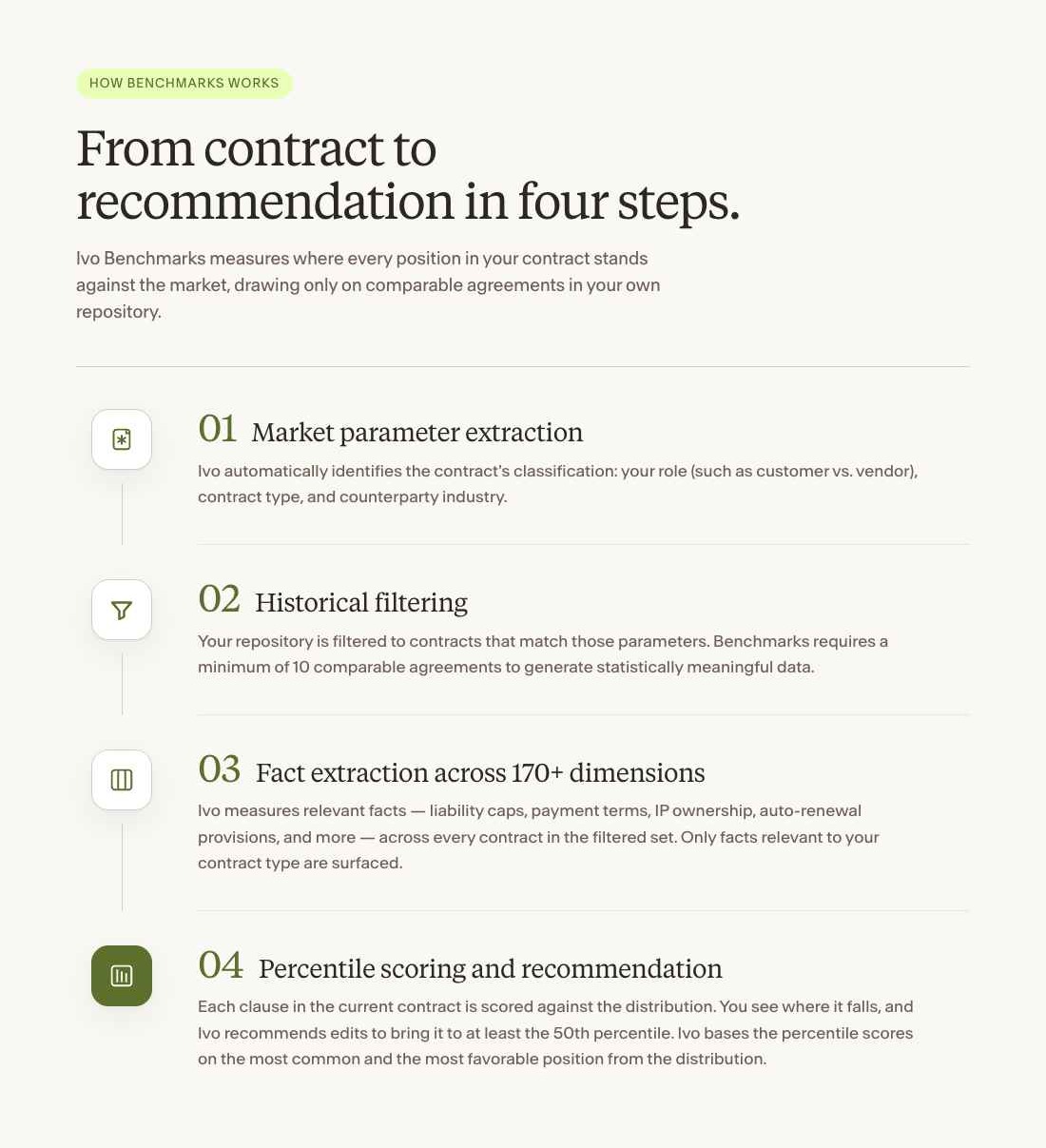
Only facts relevant to this specific contract type are surfaced. Ivo uses LLM-driven relevance filtering to skip topics that don't apply, so you're never shown a benchmark for a provision that doesn't exist in the agreement you're reviewing.
This is what Benchmarks produces when assessing annual liability caps in a SaaS agreement review.
When a provision falls below your median (for example, a counterparty is proposing uncapped liability), Benchmarks will flag it, and Ivo's review agents will draft a redline toward your 50th-percentile position, using language drawn directly from your own past agreements.
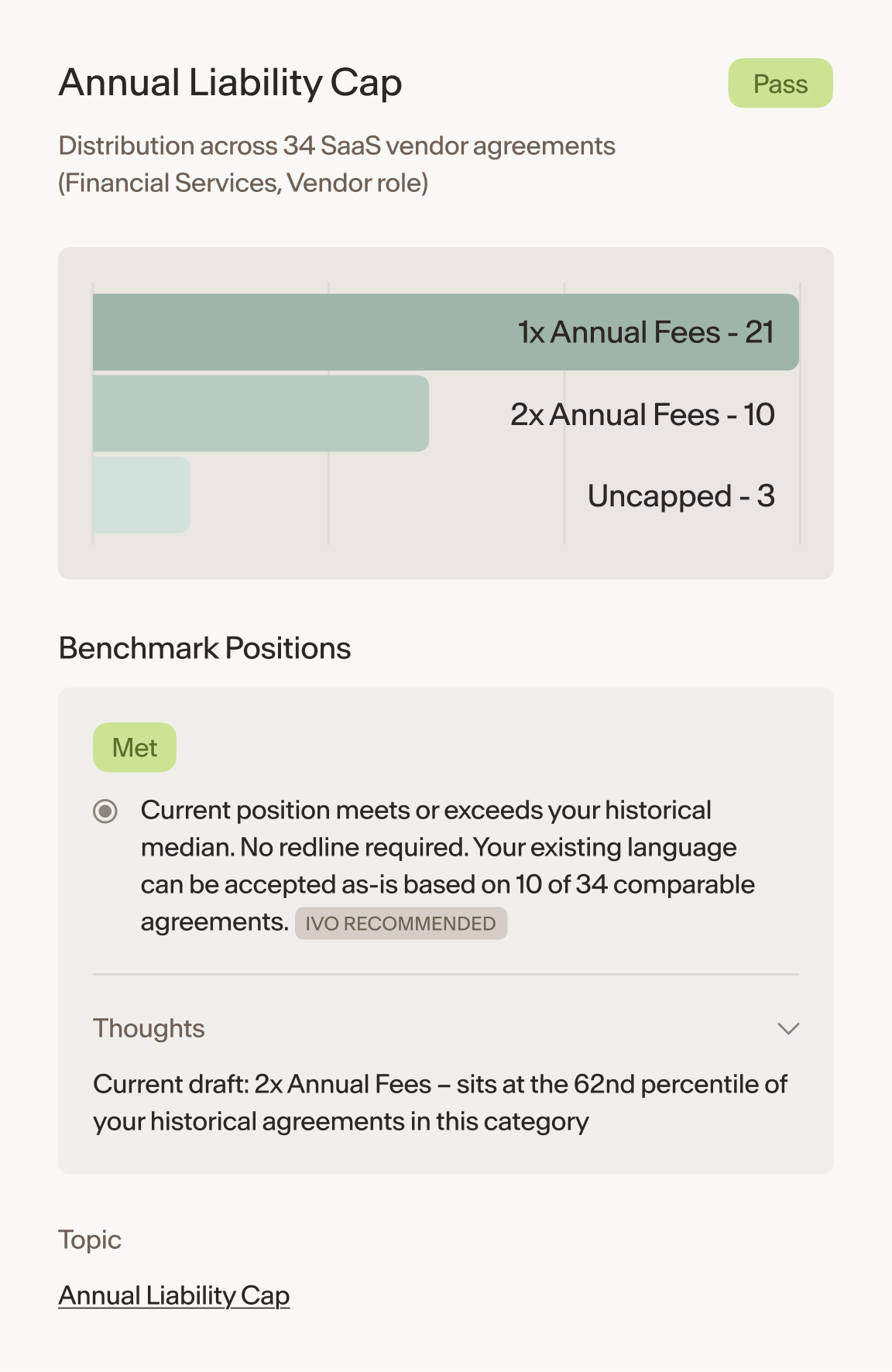
Benchmarks is most valuable when you’re reviewing high-volume agreement types where your team has built up a considerable negotiating history. Here are the patterns we see most often:
1. Vendor and SaaS MSA review
Third-party paper · Typical library: 50–300 executed agreements
Benchmarks can measure liability caps, IP ownership, data processing terms, SLA minimums, and auto-renewal windows against your history with your vendors. When a vendor proposes a mutual indemnification clause you've never accepted, Ivo will flag it with a finding like “accepted 0 of 67 times.” It will then suggest language from the agreements where you held the line.
2. Customer contract negotiation
Own paper · Typical library: 100–500 executed agreements
Benchmarks tells you how many concessions you’ve made in the past on your own paper. If a customer is pushing for a shorter term than you typically accept—say, 12 months vs your standard 24—the feature will surface a pattern like 82% of comparable deals closed at 24+ months, giving your team a data-backed position to help you respond.
3. NDA and confidentiality review
Both paper types · High volume, lower stakes per agreement
For high-volume, lower-stakes agreements like NDAs, Benchmarks is useful. Your team has signed hundreds of these; Ivo can tell you whether a one-way NDA (instead of mutual) is something you've consistently pushed back on (accepted mutual structure 91% of the time), or whether it's worth the round trip.
Benchmarks adds to your existing playbook positions; it doesn’t replace them. When a benchmark overlaps with a playbook item, the playbook position always takes precedence. Where you have playbook coverage, benchmarks add historical context, and where you don't have playbook coverage, benchmarks can fill the gap automatically, surfacing facts your team has taken positions on through hundreds of past deals.
Every benchmark recommendation shows its sources, which are the verbatim clauses from your historical agreements that define the distribution of the legal positions.
Benchmarks activates when you connect a repository of your executed agreements to Ivo. The minimum threshold is 10 comparable contracts in a given category, although most teams find meaningful benchmarks emerging around 25–50 agreements and richer distributions forming at 100+.
Once your repository is indexed, Benchmarks runs automatically on every new review. There's nothing to configure: Ivo extracts the market parameters from any agreement you review and pulls the right historical comparisons.
Benchmarks is now generally available (GA). See it in action.
Playbooks are how you tell Ivo Review your standards (e.g., the positions you take, the language you prefer, the lines you won't cross) so its redlines track to how your team actually works.
With Playbook Builder, you start from the contracts you already have. Point Ivo at the agreements in your repository, or upload from your local folders, and it will direct a few questions to you about which agreements to learn from and what to focus on. It then begins to draft the playbook from your own contracts, templates and guidance documents: standard positions, fallback language, all learned from your own precedents. You review every position in the output, choose whether it stays personal or goes to your whole organization, and save it as a playbook in a single step.
Most teams carry a long list of agreement types they've never found the time to build a playbook for at all. Now you can build those yourself, in minutes.
Every position Playbook Builder drafts comes from your own agreements, with a citation back to the contract it came from. You're never taking the output on faith as you can trace each position to the source and confirm it reflects how your team actually contracts.
Because you build it yourself in minutes, you can finally cover the agreement types your team has never gotten around to, the ones that have sat on the someday list while higher-priority work came first. More of your review runs against a real playbook instead of none.
You decide which contracts Ivo learns from and review every position before it's saved. And because creating playbooks is governed by role, administrators control who can author them and whether a playbook stays personal or becomes a company standard, so self-serve speed never costs you a single source of truth.
Playbook Builder gives your team a faster way to turn its own contracts into working playbooks, with the guardrails to keep your standards consistent. If you need any additional support building playbooks, our solutions attorneys are always here to help.
Where are your contracts right now? For many organizations, the answer is “inside a filing cabinet”— physical or digital, it doesn’t really matter which. They’re executed, archived, and consulted when something goes awry. But Adam Becker, the Director of Legal Operations at Cockroach Labs, thinks that’s about to change. And he couldn’t be more excited.
In our new series, Car Counsel, Adam describes contract intelligence as the ability to know what’s in your contracts without the manual effort that always made getting those answers so difficult. He elaborates. “[Contract intelligence is] a program that can tell you what's in your contracts without the need for traditional CLM tagging and review.” Suddenly, contracts are actually becoming useful.
Becker says that the first way many legal teams feel this shift is in moments of urgency. Perhaps a contract dispute might arise, or, as Adam notes, a global event like a pandemic makes force majeure language the most important text imaginable. You need to find that language quickly without having to sift through dozens of documents.
"If you have something that can just tell you, that's awesome, and if it's as good as a person, or close to it, that's awesome, too."But reactive retrieval is just the starting point. The more interesting question is what happens when contract data becomes proactively useful as a matter of course.
Where contract intelligence comes into its own is when legal teams can spot patterns that are valuable to the rest of the business. Becker's clearest illustration of this involves the finance team, which might want to know how many customer agreements carry 120-day payment terms. It's a reasonable business question, the kind of question that used to require a manual review project that could take weeks or months.
"That is not something that I'm particularly interested in," Becker says, "and a tool can do it for them and they can learn how to use that themselves.” Now, contracts stop being a legal artifact and start functioning as a data source. Becker imagines a world where finance, procurement, and operations can access that data themselves. The upshot is that businesses are using data, until now buried inside contracts, for actual revenue opportunities.
What Becker is describing is a different relationship between an organization and its own agreements. The intelligence was always there: buried in executed PDFs, scattered across shared drives, indexed by no one. Contract intelligence, powered by AI, makes it retrievable.
He sees this as part of a broader shift in how organizations are connecting data sources across departments to get a holistic view of all relevant data sources. "The things that we put into place should have an impact outside of legal," Becker says. That requires legal ops practitioners to think past the mechanics of contract management and into the underlying business logic. "It's not enough to say, 'Oh, they care about these five clauses in the contract, so this is how we built the flow,'" he explains. "Well, why do they care? What does it mean? What happens when it goes wrong? You need to be able to build that now."
For legal ops professionals thinking about what this moment demands of them, Becker's advice is consistent: stay curious, keep up with what leadership is being asked to do, and make sure the work you're building has reach beyond the legal team.
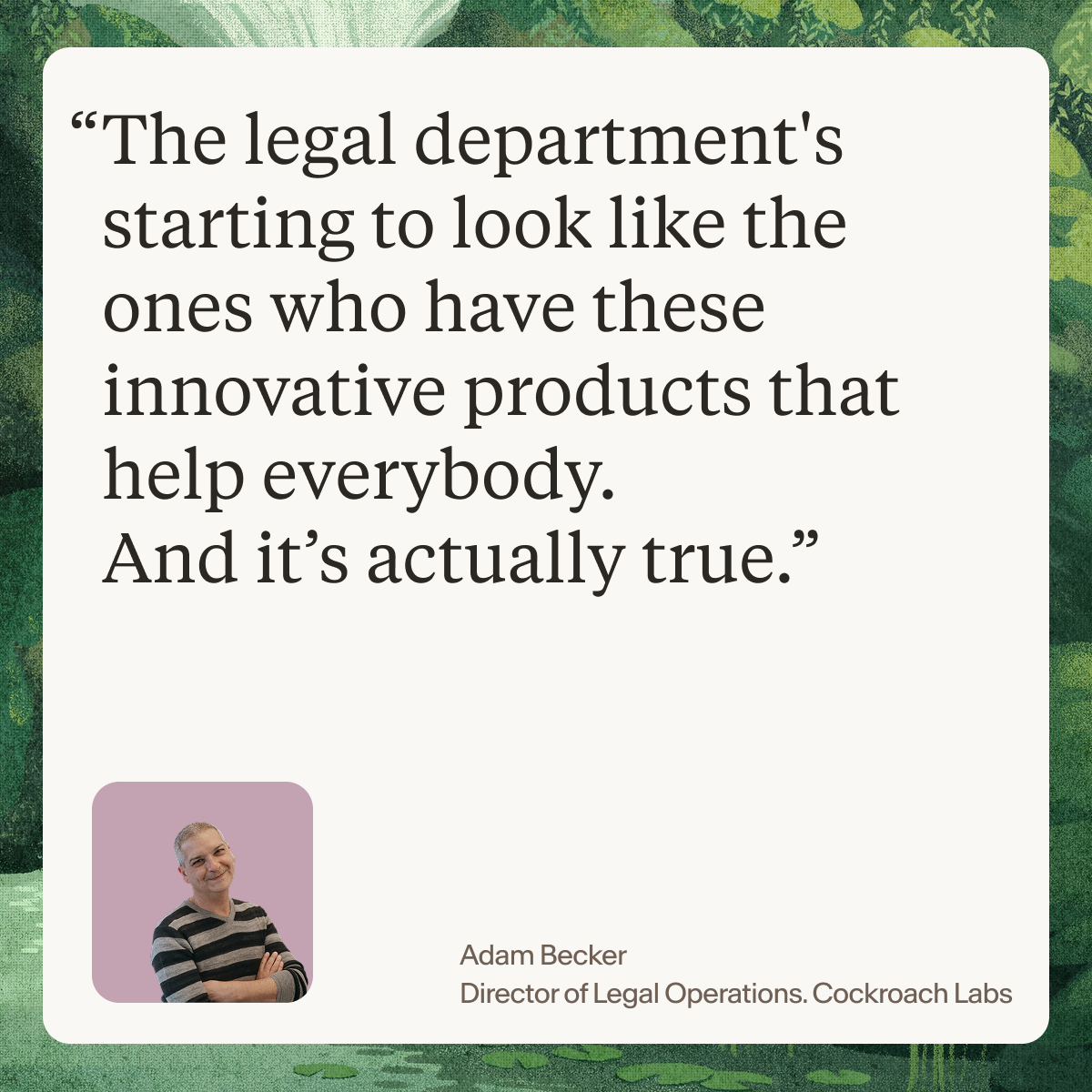
"We have to keep up with what our bosses are being tasked to do — figure out how we strategically support them as they are involved in more of the organization. And we should be, too.” After all, he points out, thanks to AI-powered legal technology, legal teams are now considered the center of innovation in many companies. "The legal department's starting to look like the ones who have these innovative products that help everybody," Becker says. "And it's actually true."
When considering adopting AI, legal teams often ask themselves whether they should buy a tool or build it in-house. We’ve seen the splashy stories: law firm Kirkland & Ellis, for example, is spending $500M USD to build its own AI tool. On the opposite extreme, former Latham & Watkins associate Will Chen has created MikeOSS, an open-source legal platform that claims to offer the same functionality as very well-known legal AI tools. Comments like this turn up regularly on the r/legaltech subreddit: “You can easily vibe code all of the functionality of [a major AI legal tech vendor] in a weekend. In fact, you can vibe code a better solution since you can customize it to your situation.”
So the question remains: with vibe coding tools, open-source projects, and general-purpose AI tools entering the legal market, should enterprises create their own AI tools in-house? Can you vibe code a legal AI tool that can do the work that in-house counsel needs it to do?
“You can absolutely vibe code a legal AI tool,” Didier Smith, Ivo’s Head of Engineering, says. “But whether that’s a good idea depends a great deal on who is doing the vibe coding.”
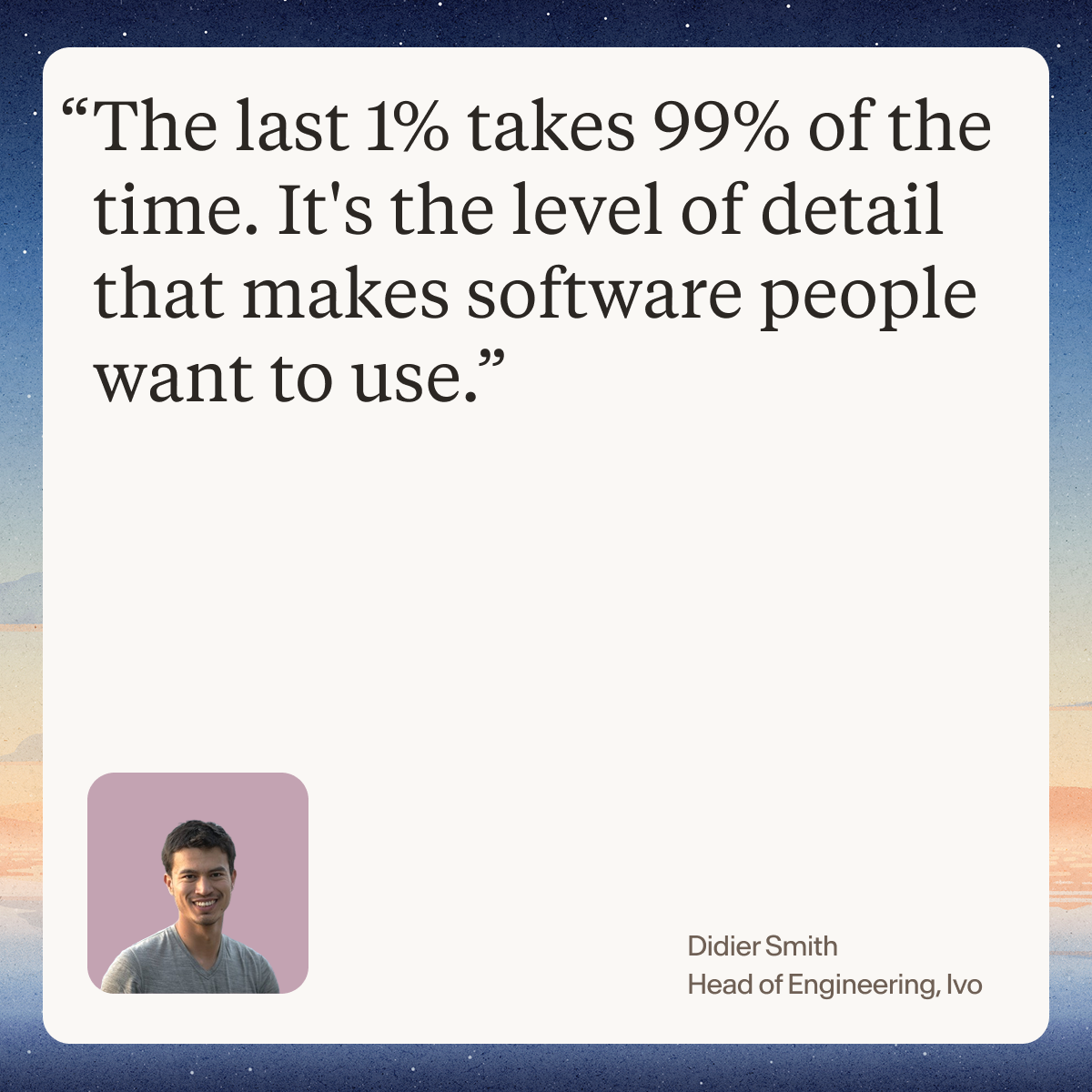
The reason, Didier points out, comes down to a software principle. “There's this rule in software called the 90/90 rule,” he notes. “Ninety percent of a software project takes 10% of the time. Then the last 10% takes the other 90% of the time. I believe that now, with AI vibe coding tools, it's actually closer to the 99.99 rule. You can get something that is 99% complete in a very short amount of time. But then that last 1% takes the other 99% of the time. It's that level of detail that makes the difference between software that normal people want to use and software that only tinkerers want to use.”
Didier notes that the best example of obsessing over this type of detail is the fate of FreeBSD, an open-source operating system that dates back to the original Unixes in the 1970s. “People have been tinkering away on FreeBSD in their spare time for about 50 years. And many people do run FreeBSD on their laptops. But they just don't know it, because Apple did the last 10%. macOS is, in fact, built on top of FreeBSD. Apple did all the bits that the guys tinkering in their spare time didn't want to do.”
The same principle applies to vibe-coded or open-source software. “People love to smash out these open-source projects when they're fired up,” Didier observes. “You go on the weekend and think: I want to build a legal AI tool, I want to build an operating system. And that first 99% is really satisfying because you just have your concept in your head and you bash it out and you've got something that sort of works. But then you run into the edge cases you didn't anticipate. The number and diversity of those edge cases determines how long you're going to be grinding away before you have something that's actually acceptable in practice.”
Didier elaborates on why the profession of law, in particular, has such a high number of edge cases. “One reason is purely technical,” he says. “Lawyers deal a lot with Word documents, and Word documents are an obscure, complex format. Lawyers care a lot about formatting—the numbers on their bullet points, the clause numbers—and those have legal implications. Getting a clause reference wrong can actually cause trouble down the line. So just editing a Microsoft Word document in a way that a lawyer would be happy with is surprisingly difficult. And then there's the legal substance itself. A lot of people think contracts are like code written in English, but that's not true. Code is designed to be unambiguous, whereas contracts are often designed to be ambiguous. Lawyers, when negotiating a contract, are under a dual tension. They have to protect their company from risk, but they also need to get the deal closed. So they'll deliberately put in ambiguous language that lets the deal move faster—language they can later fall back to arguing in court.”
Didier points out the importance of domain expertise in both engineering and law. He notes that the two professions have different skill sets, which means lawyers are unlikely to enjoy using open-source or vibe-coded software. “The people who can orchestrate agents and vibe code Claude Code instances just tend not to be the same people who know the difference between a good redline and a bad redline. This is why we have companies with different people in them and different departments—so the people who are great at programming can focus on programming, and they can leverage the domain expertise of people who are great at law.”
That said, he points out, there is some crossover between people who enjoy vibe coding and people who are good at practicing law. And in those cases, it’s possible that creating these types of software projects might be a good solution to working more efficiently. “If you're a tinkerer and you like tinkering, and you don't mind when your software kind of breaks a little bit because you can fix it, and you enjoy that, then it probably is a good idea to tinker away and build your own legal AI setup. But your average lawyer won’t want to go through the grind that it takes to build something that works really well in a high-edge-case environment. And if it breaks, the lawyers aren't going to be the ones to fix it. They're just going to say it's broken. You're not going to get the lawyer open-source community submitting PRs to your GitHub,” he jokes.
Didier is clear that none of this is a criticism of the tinkerers themselves. If you enjoy building, you should build. The question that legal leaders should ask themselves is whether these types of tools will survive contact with a legal team under pressure that has neither the time nor the inclination to scrutinize their output or fix them when they break.
Connect with us now to learn how we can streamline your contract review process