Extracting insights from agreements with AI is an iterative process. You set up a field, run it across a handful (or even a large number) of contracts, and eventually you notice it's pulling the wrong values or missing nuance that your team actually needs.
That doesn’t have to happen anymore. The new “Optimize Prompt” feature on AI fields runs in the background and automatically analyzes how a field's prompt is performing across the contracts in your workspace. It identifies where extractions are going wrong, and generates guidance instructions to improve accuracy without the need to manually edit prompts.
A good-quality prompt is the difference between extracted insights you can trust and ones that you have to double check. But diagnosing how a prompt is going wrong isn’t always easy, especially for large enterprises that are working with thousands of contracts with varied language, structure, and deal terms.
Now, prompts are improved automatically, using the real contract data in your workspace to understand where the prompt is underperforming. The result is a field that gets more accurate without requiring you to become an expert in prompt engineering.
This feature is currently available to all Ivo customers, and can optimize 5 prompts at any one time. It’s a change that will have a meaningful effect on data quality, and is one less thing your team has to manually manage.

We hear anecdotally that trying to figure out which AI contract review tool is the right one to purchase is a very difficult process. There are a lot of companies in the category, they all say the same things, the category is noisy. “We spent upwards of two years evaluating these tools,” one customer told us. “It was a grueling process.”
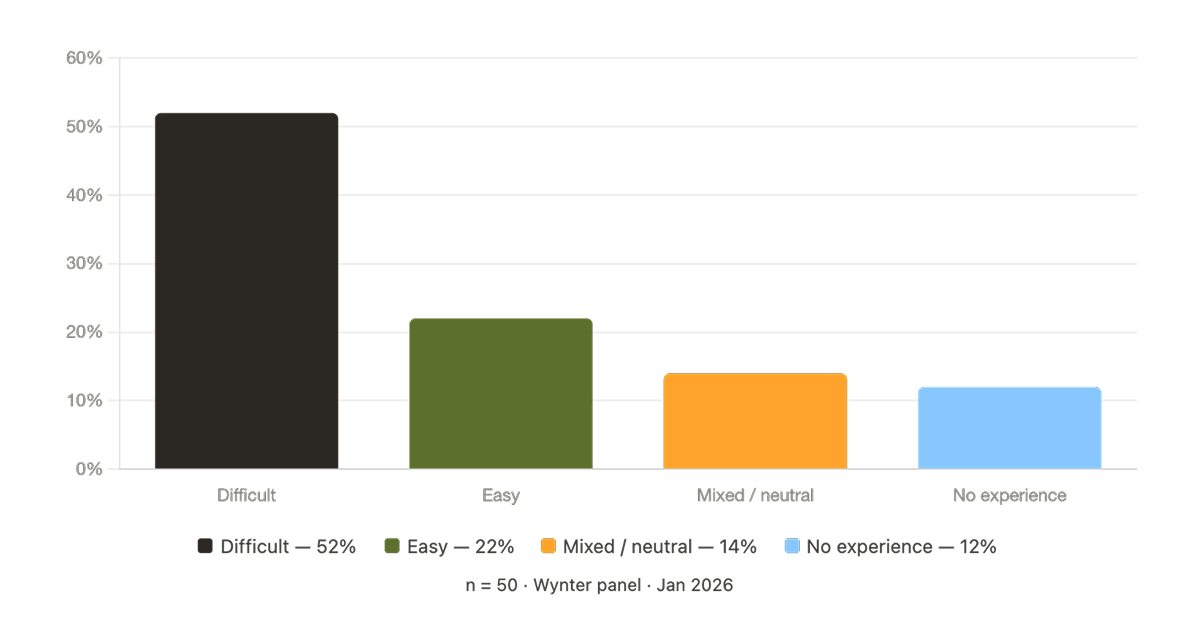
We wanted to know if the data supported what we’ve been hearing, so we surveyed 50 legal leaders across enterprise and mid-market companies to find out what it’s like to evaluate AI legal tools.
More than half said it’s difficult to determine which tool is the right one. Only one in five said it was easy.
Lawyers are certainly using AI; 87% of general counsels say that their teams use generative AI for all sorts of legal tasks, like research, document drafting, and contract analysis. What has happened in the last several years is that AI’s increasing capabilities have led the software category of AI-powered legal tools has grown exponentially; in fact, faster than buyers’ ability to assess it.
In-house counsel, legal ops leaders, and procurement teams told us they are being asked to make significant purchasing decisions in a category that's crowded, noisy, and in some cases, hard to trust. And the industry isn't making it any easier.
The responses from the 52% of lawyers who found evaluating tools difficult clustered around five distinct themes.

The frustrations they’re feeling are clear; these are all signs of a noisy market making claims that are hard to verify.
The most common complaint, cited by nearly a quarter of respondents, was that it’s difficult to differentiate one legal tool from another.
"There are lots of overlapping claims but vendors are at different stages of maturity, accuracy and security," said one general counsel at a mid-market pharma company. "So you have to pilot so you can compare tools."
Another respondent, a senior counsel, put it more bluntly: "After a while, I get AI vendor merge where they all seem to offer the same software functions."
When every vendor claims to do contract review, redlining, playbook management, and AI-powered analysis, buyers lose the ability to distinguish between them, and that’s not a way to make great business decisions.
Another common concern was the difficulty of assessing these tools’ accuracy.
For legal professionals, this isn’t an academic concern. The stakes are high. Nobody wants to get sued because an AI hallucinated or came up with the wrong answer. So when legal teams evaluate a tool, they want proof it actually works. But proof is hard to get.
"The top two things I'm worried about — hallucination and accurate representation of the law — seem nearly impossible to evaluate without redoing all of the work manually," said one senior counsel. "I'm not sure how to better investigate the accuracy."
Another respondent described numerous variables that make accuracy almost impossible to pin down: "The accuracy of AI is hard to define. Results vary dramatically based on prompt quality, document structure, data cleanliness, user expertise."
Sixteen percent of respondents identified the gap between a vendor demo and real-world performance as a primary frustration. The pattern was consistent: tools look like they work well in controlled conditions but disappoint in actual use..
"When you see a demo, it is showing the product in its best light, but when you use it, it may not be as effective," said one corporate counsel responsible for AI technology procurement at a large manufacturer.
A privacy and cyber liability attorney framed it as a structural problem: "Most companies you really need a proof of concept to actually evaluate, because their usefulness in a demo or on a website just doesn't show how they would work for your use case."
This gap isn't unique to legal AI. It’s tough to take a category where accuracy and workflow fit are non-negotiable, and where the cost of a bad decision is not just measured in time or money, but in serious negative consequences for the company.
Fourteen percent of respondents called out vendor overpromising as an obstacle to good evaluation. Examples cited included products pitched as production-ready that are still in development, RFP responses full of buzzwords that don't map to actual features, or products designed by people who don't understand legal workflows.
"Many overused buzzwords in the RFP responses and some proposed products/solutions were still in the ideation phase," said one senior legal counsel currently running a formal RFP process for their organization.
A lead counsel at an enterprise SaaS company noted: "Many of the features they show are either basic and should be in any type of tracking tool, or are not something attorneys need. You can tell which were designed by attorneys."
Legal professionals’ work is specific and well-defined. That’s why specialized tools that reflect their workflow are so important. AI tools have to suit how attorneys already work, not force lawyers to fit their work into new directions.
There were several key themes that arose from the 22% of legal professionals that found assessing AI tools easy. During the evaluation process, they had clear decision-making criteria, direct access to test the tool on their actual work, and enough familiarity with AI to know what questions to ask.
"I find it pretty easy to evaluate AI vendors because it comes down to whether their product works well or not," said one patent attorney. "Many tools don't seem to understand the actual needs of patent attorneys or understand what our workflow is really like."
The vendors that make evaluation easier are the ones that provide real evidence — in benchmarking data, real-world trials, and customer references — that their products work in conditions that resemble the buyers’ own.
Legal professionals have an aversion to puffery. They’re not fooled by slick demos and marketing fluff. They want to know whether AI tools will do the specific work they’re tasked to do.
The vendors who earn their trust will be the ones who make evaluation easy but by providing transparent, evidence-based information that legal professionals can use to make good decisions.
__________________
This post draws on a survey of 50 in-house legal professionals conducted via the Wynter panel in January 2026. Respondents ranged from associate attorneys to General Counsels across enterprise and mid-market companies.

“I’ve been looking at contract review tools for many years, and Ivo was the first one that actually did what it claimed to do,” Suhayb Ahmed, the Head of Commercial Legal at Canva told us. “That was a real wow moment for me.”
Suhayb has been leading the charge to build an AI-first legal team at Canva. To him, that means redirecting lawyers’ time to do the work they can do better than anyone else: using their strategic judgement to solve problems. "An AI-native legal team means using AI to handle the high-volume, low-impact work that takes up so much of our time, so we can focus on what makes us human: applying strong judgment, making decisions, building relationships."
That strategy has changed how Canva's legal team approaches contract review and redlining entirely. Instead of spending time crafting the exact right language, lawyers focus on the judgment calls that matter most.
"How do we best protect our business?” Suhayb notes. “How do we help move the deal forward while still achieving the needs of the counterparty? We can use Ivo to say, this is what our business needs to achieve, so we can focus our efforts on what actually has the bigger impact pays lots of dividends in allowing us to focus our efforts in the right places."
One of the most compelling things about Suhayb's story is how quickly Ivo's value spread beyond the legal team. For example, when Canva's revenue accounting team needed a quicker way to review executed contracts for key terms, Suhayb showed them what Ivo Intelligence could do.
"They're reviewing every single contract for a bunch of terms to ensure that they're recognizing the revenue in the right way. With Ivo, they can just build a spreadsheet with a prompt for each of the key terms that they're looking for. They've got all the details that they need and they can then apply the revenue accounting principles based on the details that are already surfaced to them."
If you’re just getting started with AI, Suhayb has very direct advice.
"Don't wait for the perfect prompt. Just start experimenting and iterate from there and you'll find these amazing solutions that just make your life a lot easier."
Take a look at how Ivo could create value for your team.

Carla Michel has always believed in the power of technology to solve problems. And she knew that AI could solve one of the biggest issues her team faces.
As Director, Senior Corporate Counsel at CDW, a Fortune 500 business offering technology solutions for companies in industries from healthcare to government to education, Carla oversees a high-volume, high-output legal team. Their work covers everything from technology licensing to managed services. It’s fast-moving, resource-constrained work, and for years, she was determined to find smarter ways to do it.
"Everything's rush, rush, rush," she says. "As most people with corporate in-house departments understand, you have to learn to do more with less."
Her first answer to improve slow, manual legal processes were comprehensive, carefully built playbooks that gave her team clear direction and allowed her to bring in support quickly when volume spiked. It worked, up to a point. But Carla knew there was a next step coming, and that was automation.
"Within the type of work that we do, there's a lot of what I would call low-hanging fruit. It's time-consuming and not interesting after a while. I knew that AI was coming into development, and I just kept a lookout for it. I'm like, surely there is going to be something that's going to help us automate the process."
In mid-2024, Carla and her team began the process of evaluating legal AI tools. They tested several, and she notes, the differences were clear. "Ivo definitely had the best results of all the ones we tested."
But to Carla, the real power of Ivo isn’t just automating contract review processes, though that has been valuable to her team. The real unlock for her was the combination of the review tool and Ivo Intelligence, which allows CDW the ability to gather business insights from their entire library of agreements going back decades. This unlocked some very powerful capabilities for Carla's team.
"The ability to derive data from large volumes of contracts is something that we've never had the ability to do before. Now…we're able to know exactly what our contracts say at any given moment. But even more importantly than that, we get to see on a broader basis how we contract with certain categories of suppliers. Where our sticking points are in our negotiations, where we need to evolve."
The ability to look across a portfolio of contracts and understand patterns, benchmarks, and negotiating positions at a level that simply wasn't possible before. She says, "[Intelligence is] a way to produce a better result in a shorter period of time. The functionality of that tool just never ceases to amaze me. The capabilities are just unlimited."
There’s a lot of noise in the market about how important working with AI is; there are hundreds of vendors and so much chatter about the right way for legal teams to adopt AI in their workflows. For legal teams still on the sidelines, Carla's advice is simple and direct.
"My overall advice would be: just start. Find a partner that you can work with that's going to give you the post-purchase support."
That last point matters to her. Adopting AI isn't just a technology decision. She notes that buying an AI tool is not just about purchasing software, it’s about learning to change the way her team thinks and works, and the quality of the partnership makes all the difference. And she believes she’s found a great partnership with Ivo.
"I can say that the partnership we've had with Ivo has been instrumental in the AI journey. I've never worked with a more supportive team in any facet."
One of the most important ways Ivo makes legal teams’ lives easier is by meeting our users where they already work. Attorneys have established workflows and processes. They don’t want to change what’s working for them or spend time learning new tools.
This is exactly why we focus on tools that legal teams already use every day.
We know many in-house legal teams work directly in Google Docs.
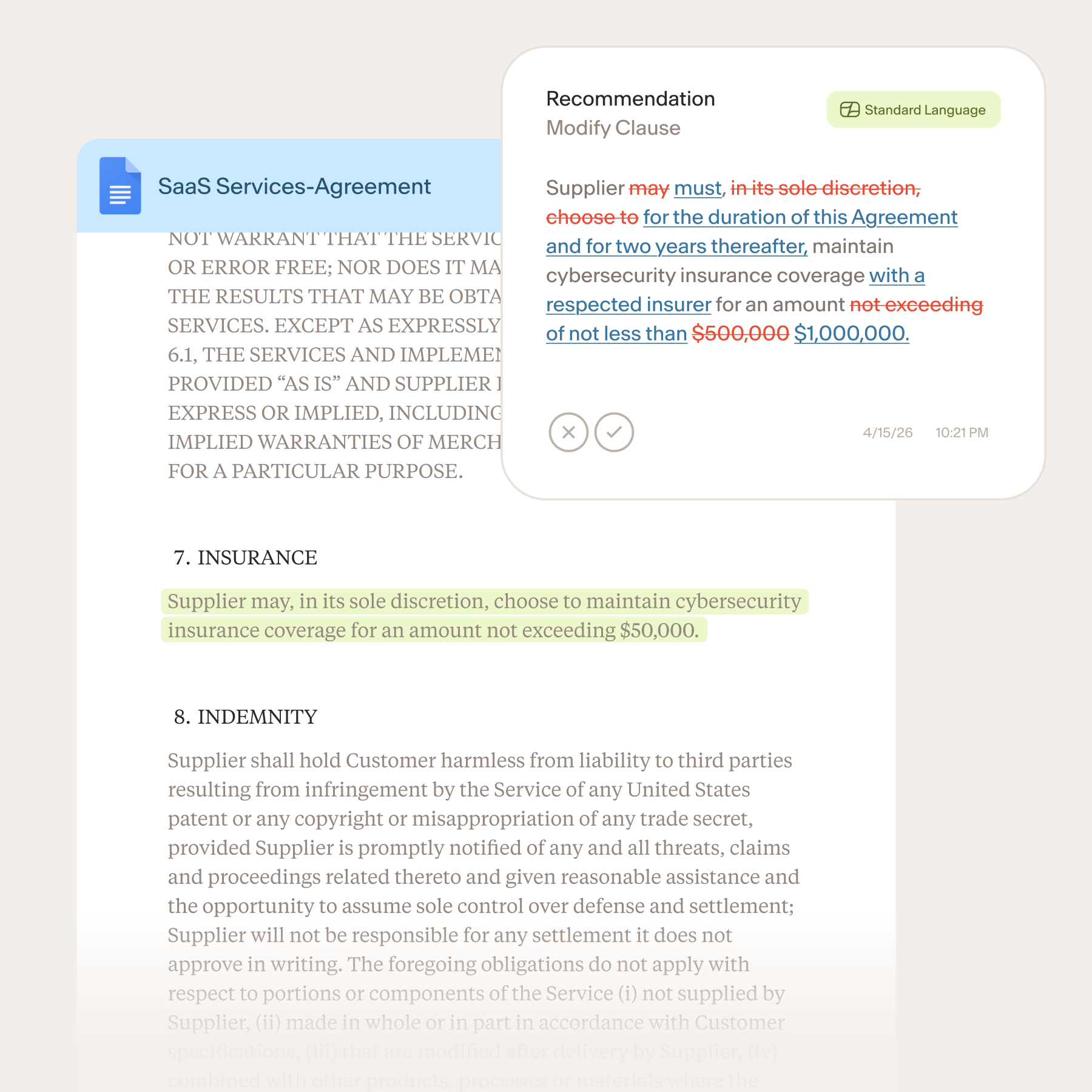
Today, we’re excited to announce that Ivo now supports Google Docs via a Chrome extension. You can now redline, review, and analyze contracts directly in Google Docs, without needing to convert or export files.
Ivo is the first to bring contract review directly into Google Docs. For teams already reviewing agreements there, this is a natural extension of how you work.
The Ivo Chrome extension offers the same contract review and analysis experience as our Word add-in and sits alongside your document just as it does in Word.
Building this was not straightforward and posed significant engineering challenges. To deliver the full-featured experience our users will now get to experience, the product team had to develop and rely on a number of creative technical workarounds.
We chose to prioritize a true Google Docs integration, despite the high technical barriers, because our customers wanted it. That decision is exactly why Ivo is the first legal tech company to deliver this capability.
The customers that pushed hardest for this feature are exactly the ones Ivo is built for: sophisticated in-house legal teams handling high-volume contract work. For them, Google Docs support is a requirement. We heard that clearly and built accordingly.
If your team relies on Google Docs and is looking for a powerful AI-driven contract review solution, Ivo is now built to fit directly into your workflow.

We know that reviewing and managing contracts with AI has made a meaningful difference for legal professionals. And as more and more companies adopt AI to review and extract intelligence from contracts, we’re flowing more and more data through frontier AI models. Large enterprises manage, on average, 350 contracts a week. That’s a lot of information to query and can cost a great deal both in money and time.
As AI has grown and matured, however, new, smaller, and more focused models have emerged that can handle different types of queries. So my research right now centers on being able to dynamically decide which types of queries should go to which types of models. It’s like using a scalpel vs a bazooka. Some use cases are best suited for small, focused models, and others are best suited for generalist models.
You want to use smaller, simpler models for simpler questions, and reserve the big frontier model for when it's actually needed. That way you preserve quality while gaining speed and cost efficiency. Smaller models are exponentially faster. The idea I'm thinking a lot about is: what is a simple question, and what is not a simple question? Once the tool can figure it out, it can route accordingly.
The models that people think of as "AI" like ChatGPT or Claude were designed from the start to be generalists. They were trained on essentially the entire web, and kept growing in size until researchers said, okay, these are too big, let's try to shrink them while preserving capability.
Then a different line of research emerged: what if we made models much smaller and trained them for specific tasks? It turns out that for narrow, well-defined tasks, smaller models can actually beat frontier models, especially after fine-tuning. Recent examples include Chroma’s Context-1 model for information retrieval, while being 10x faster and 25x cheaper; Cursor’s Compose-2, a fine-tuned version of Kimi K2.5 that provides frontier level coding capabilities at a fraction of cost, and Intercom’s Fin Apex, a model fine-tuned for customer service that beats frontier models and provide 65% less hallucination and better resolution rate.
Using frontier models for everything is fine until it isn't. It's expensive, it's slow, and it's entirely outside our control. These models might live on Anthropic's infrastructure, or Azure, or whatever cloud platform. If there's an outage, we're dependent on someone else to fix it. Any centralized service has a risk of disruption due to geopolitical instability, or environmental issues, or any number of factors.
The nice thing about smaller models is that you have much more control over them. You can host them yourself. You could run them locally, or on servers in whatever region your clients require, perhaps to meet UK data residency requirements, for example. There's engineering work involved in hosting and scaling that infrastructure, but you gain control of the model, you get independence from pricing changes, the work is much less resource-intensive, and is a fraction of the cost.
One of the things I find most fascinating about the AI legal space is that the biggest blocker to my research is the lack of legal benchmarks. Legal has almost no benchmarks. There are a few contract-specific ones out there — limited, mostly English-only, not perfect. But the deeper issue is that legal work has never been systematically evaluated. Medicine has outcomes. Code either works or it doesn't. In the legal industry, if a contract term is wrong, sometimes nobody finds out until something goes to litigation.
As we start using AI for more aspects of legal work, we need solid, curated benchmarks so that when we release or update a new model we can compare them: here are the questions, here are the answers we got yesterday, here's what we got today. What changed? Is it better or worse? We're trying to apply quantification to a field that's never had it before. There are really only two options: either trust the frontier model completely, which is risky, because they can make mistakes on surprisingly simple things, or get humans to actually label a set of contracts and build a reference benchmark from that.
A number of larger companies are already moving toward dynamic model selection, but my prediction is that legal AI vendors are going to be thinking about how to do this in the future. I believe that thinking through what use cases need a scalpel vs a bazooka will have a strong influence on how legal AI products are built.
.jpg)
The single biggest problem that I’m seeing with my customers right now sounds like a simple one. Nobody can find any of their contracts. Most legal teams can tell you where their contracts are stored. Very few can tell you what's actually in them, and even fewer can act on that information in real time. And that creates a lot of unanticipated problems.
The research confirms what my customers are saying. On average, organizations keep their contracts in 24 different systems. This means that there is an incredibly high reliance on institutional knowledge within legal teams to find anything. It also creates enormous onboarding problem which can have far wider business impact. How do legal departments train someone to find answers to questions about their agreements when they themselves don’t know where to look?
It’s having a profound impact on how legal teams are doing their work. We hear from attorneys that “we don't know what we've agreed to.” There are so many obligations, auto-renewals, and pricing issues buried across hundreds of contracts that teams have no visibility into. Those obligations affect the entire business but because no one has any visibility into the agreements, decisions are made without keeping these obligations in mind. “Legal is always the last to know,” one attorney told us.
This isn’t just a people problem, it’s a financial one too. According to Gartner, lawyers spend 25–40% of their time on the administrative burden of unmanaged contracts. It’s not just reviewing them; it’s finding them and figuring out what’s actually inside them. Businesses lose an average of 9% of annual value through poor contract management, due to cost overruns, invoicing errors, delayed delivery, and avoidable disputes.
Ultimately, it forces in-house lawyers to still behave like private practice lawyers, where the company is their only client. They have to operate in a 24/7 always-on mode where they don't get to do anything but react to their client. But they're actually in the business. They could have a bigger impact. They’re full time employees and they have access to all the documents, so why can't they go and proactively solve problems?
Most executives know this is a problem. They’re absolutely aware that this is a slow drain on their business. I believe that’s why the first piece of technology many legal teams turn to is a CLM. If they’re having trouble managing contracts, then it makes sense to choose software that’s designed to take care of that job. But when I hear from people who actually have experience implementing them, it just sounds incredibly painful. They have to do so much work to get a CLM maintained properly that it just becomes something they're not really interested in.
I think it’s important to shift legal teams from a bottleneck to a strategic asset. No one really wants to spend ages doing admin on documents. But when I was trained to be a lawyer, one of my consistent problems was making sure the name of the document was right and it was in the right folder. I’d be working with documents which are titled v.1, v.2, "FINAL VERSION ALL CAPS," and you're wondering, which one's the right version?
It’s a core principle of how Ivo is built; we treat contracts as a specific type of document and understand how they relate to each other. But most contract management systems treat documents like they're just files that are separate and distinct from each other, not understanding their relationships. So showing legal teams Ivo Intelligence is like going from a system of record, like putting books on a shelf, to seeing a complete 3D map. It's going from a 2D world to a 3D world. So when I show them relationship mapping, this is something they're wowed by. They breathe a sigh of relief. They say, “that would solve me spending ages organizing folders in a drive.” That’s the kind of admin work that nobody really wants to do.
I try to conceptualize this like building blocks. I think that starts to get the wheels turning. The first step is that they have systems which have files and then subfiles and then subfiles, and they have to be really pedantic about naming conventions and knowing which one's the correct version. And now they can do this instantaneously. And the next piece is, what do you then do? Now you've got the documents in an organized way, how do you extract the data in a way where it’s useful to you and you can see everything you need?
I recently worked with a customer that has quite specific SLAs about their platform’s uptime, performance and support. And just tracking that is something so simple for Intelligence, but before they had the product, it was almost impossible. They discovered that they have lots of unique clauses in their contracts that they weren’t really aware of before. But they’ve gone from a system where they didn't know, to now they know. And now they can do something about the situation.
The technology exists where legal teams should be able to be proactive, not reactive, about renewals, obligations, and risks, and they should be able to answer questions from the business in minutes, not days. And being able to show people that technology, and help them move their way of working to a more strategic, proactive role in the business, that’s a really satisfying part of my job.
_________
Want to help companies re-imagine how they work with contracts? Take a look at our open Account Executive Roles.

I recently saw that Ivo is one of the best places to work in the world if you’re an account executive. According to RepVue, we’re in the top 5% of sales organizations globally and the #3 sales organizations worldwide for inbound lead flow.
I’m not surprised. I’ve been working as an account executive at Ivo for the past year, and I can honestly say it’s one of the best places I’ve ever worked as a seller. I’ve been fortunate to work some incredible deals during my time here, and thinking about what’s made my time successful, it’s due to three factors.
Product-market fit. There is a need for our product. What could in-house legal teams accomplish if they weren’t stuck, day after day, in the tedium of manual tasks? We’ve seen time and again from our customers that when you combine the ingenuity of lawyers plus the information processing ability of AI, fantastic outcomes happen. Lawyers, revenue operations leaders, finance departments, procurement teams all want Ivo’s platform; by eliminating the bottleneck for legal, we unlock business insights for other departments.
Access to the product team. One thing I have noticed, when selling to enterprise customers, is that they expect the product to be configured to how they work. At Ivo we approach this customer need with deep curiosity and a genuine collaborative spirit - something that has not been my experience prior to joining Ivo. Sellers at Ivo have access to the engineering team, product design team, leadership and that means that end users have access to these individuals. Perhaps it is my former life as an attorney, but I feel that one of my main responsibilities as an Enterprise Account Executive is to advocate for my customers' needs. Ivo has embraced my approach, and has created an exceptional environment of cross departmental collaboration.
Culture. This factor is hard to define but easy to identify. Part of our brand promise is creating a world-class product, and doing that is incompatible with indifference. People here care about our work, they care about our customers, they care about the problem we’re solving, and we care about each other. You can see it in everything they do. And when you have an organization that takes such deep care in its work, that makes the practice of selling a thousand times more meaningful.
When you’re selling an AI product, you’re not relying on a traditional software sales playbook. You’re selling a partnership based on a shared vision and a promise to evolve together as the technology evolves together. That means that our values and our customers’ values align.
Ivo has fully returned to the office; the team is in San Francisco five days a week. I don’t think I would have been able to fully immerse myself in the Ivo culture so quickly, nor would I have had the access to the Ivo team that I need to close deals if I weren’t in the office. It really is true that collaboration is so much easier to achieve face-to-face than over remote tools, and I can often get requests completed in minutes that might take hours if I asked for them in a message. Everything is a tradeoff, but for me, the benefits I experience as a seller by being in the office outweigh the drawbacks.
I’m excited to have a front seat to the future of AI technology working with Ivo. If you feel the same, take a look at our current job openings and see if there’s something that interests you.

Ivo Assistant can now review a contract in the context of your historical agreements housed in Ivo Intelligence. There is so much valuable knowledge in your contract portfolio about historical negotiating positions, or how a company tends to negotiate specific provisions, which is too often locked away in documents or inside lawyers’ heads. Now, Assistant makes that knowledge available to make negotiation easier and contracting more consistent.
This new capability is beneficial for in-house legal teams for a number of reasons:
It turns your past agreements into institutional knowledge. Many legal teams have years of negotiated contracts sitting in a repository, but that institutional knowledge is locked away. Now, all of that historical intelligence is both accessible and actionable. You can actually use every precedent your team has ever set in your next negotiation.
It gives negotiators a defensible baseline. A difficult part of contract negotiation is knowing what the market standard is for your own organization. With this new capability, teams can now point to concrete historical data in their negotiations, e.g. "We've accepted this clause in 12 of our last 15 agreements,” rather than relying on historical memory.
You no longer have to reinvent the wheel with every contract. Lawyers spend a shocking amount of time digging through past agreements to remember how they've handled a particular clause before. This reduces the research time from hours to minutes, and provides reliable, accurate results as well.
It standardizes legal processes. Legal ops leaders know that legal teams need consistent, repeatable processes to scale and provide business value. Being able to benchmark a new contract against the historical norm creates consistency across regions and teams, and helps reinforce standard procedures.
Here are a few prompts that you can use with Ivo Assistant to take advantage of comparing new contracts against historical precedents :
Here are some best practices to keep in mind as you prompt Assistant:
We’re excited about this new capability, as we think it will have numerous benefits for in-house legal teams. Give it a try and let us know what you think.
Connect with us now to learn how we can streamline your contract review process